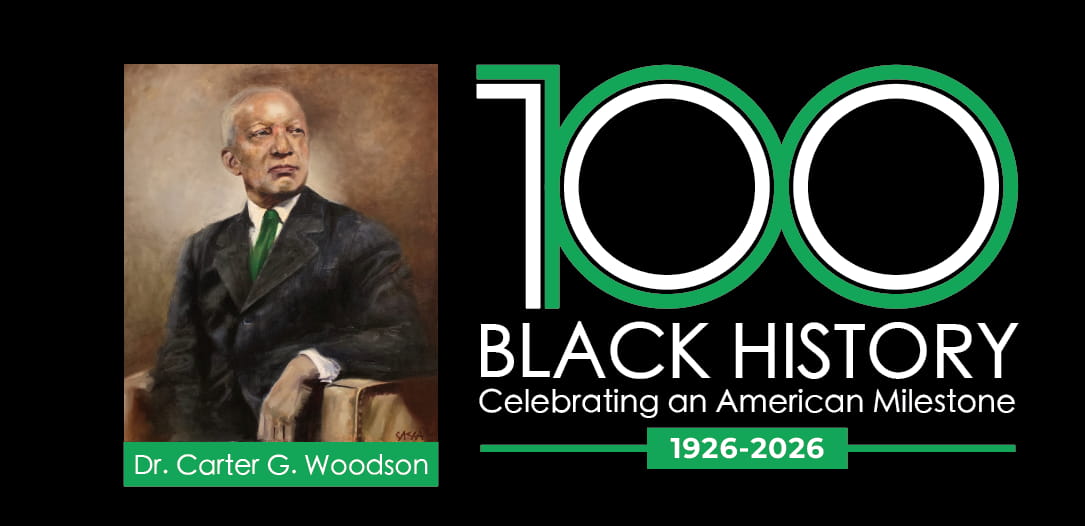
In a groundbreaking initiative to honor and rediscover a rich history, Marshall University is collaborating with the City of Huntington and Marshall Health Network to commemorate a great epoch in the American story – the centennial of Negro History Week/Black History Month.
Marshall University President Brad D. Smith and Burnis Morris, Carter G. Woodson Professor in the School of Journalism & Mass Communications and director of the Woodson Lyceum, are co-chairs of the Negro history Week / Black history Month Centennial Committee – whose members include Huntington mayor Patrick Farrell; Scott Raynes, CEO of Marshall health network; and Ericke S. Cage, president of West Virginia State University.

The observances involve free online courses, a symposium in March and performances by the outstanding artists (listed below) who share interesting perspectives about Black history – in the tradition estabilshed a century ago by D. Woodson, the revered Father of Black history who made his mark on our community before establishing Negro History Week in 1926.
Rising Stars Fife & Drum Band
Monday, February 2, 2026 7:00 PM
Joan C. Edwards Performing Arts Center
Shardé Thomas Mallory and Chris Mallory from Coldwater, Mississippi, are the dynamic duo behind The Rising Stars Fife and Drum Band. Shardé has led fife and drum bands since her granddad, Otha Turner, was alive and leading his own band that she was a part of. In 2003, Shardé started her band, Rising Stars, to continue her grandfather’s legacy. In recent years, the band has grown into a worldwide brand and monumental blues/roots history sensation.  The mixture of old school songs with fresh funky beats is bound to keep the young and old on their feet!
Music featured in the major motion picture, “Sinners.”

DR. OLLIE WATTS DAVIS
AND THE UNIVERSITY OF ILLINOIS BLACK CHORUS
Saturday, March 7, 2026 4:00 PM
Joan C. Edwards Performing Arts Center
Described as “a bubbling stream of a voice, remarkably smooth down into a resonant, rich low register” (San Francisco Chronicle), Olie Watts Davis earns superlatives wherever she sings. Since her New York debut at Carnegie Hall, she has appeared with many of the nation’s leading orchestras; in opera with the San Luis Obispo Mozart Festival, the Opera Theatre of Saint Louis, Des Moines Metro Opera, Opera Theatre of Springfield, and Illinois Opera Theatre; and internationally for performances and residencies in the Americas, Europe, Africa, Asia, and Australia.

FREE Tickets
For FREE Tickets Call 304-696-6656
– or –
Get Tickets at the Marshall Artists Series Box Office Mon – Fri 12 PM – 4 PM or 1 Hour Prior To Each Event
2026 Black History Month Poster and Merit Award Winners
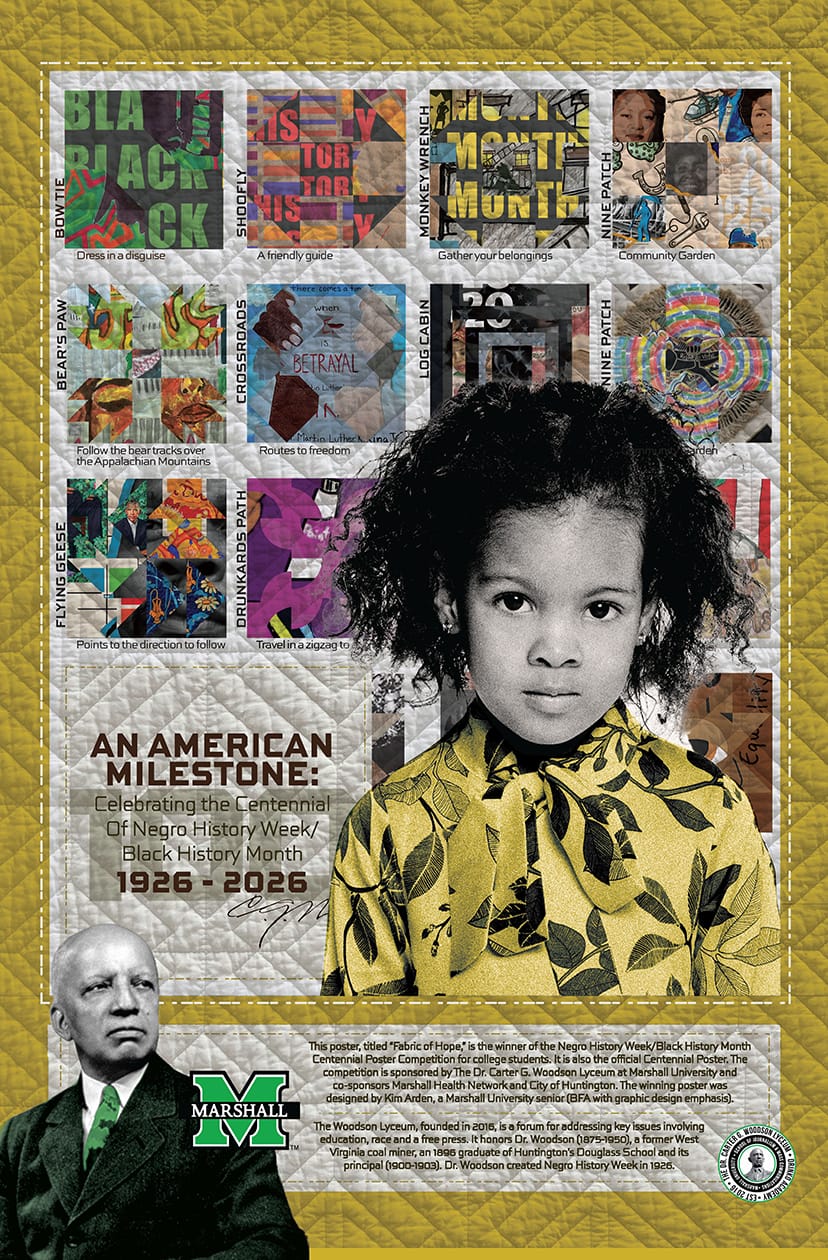
First Place (2026 Official Black History Poster of the Dr. Carter G. Woodson Lyceum)
Kim Arden
Marshall University senior, BFA, Graphic Design emphasis and minor in marketing
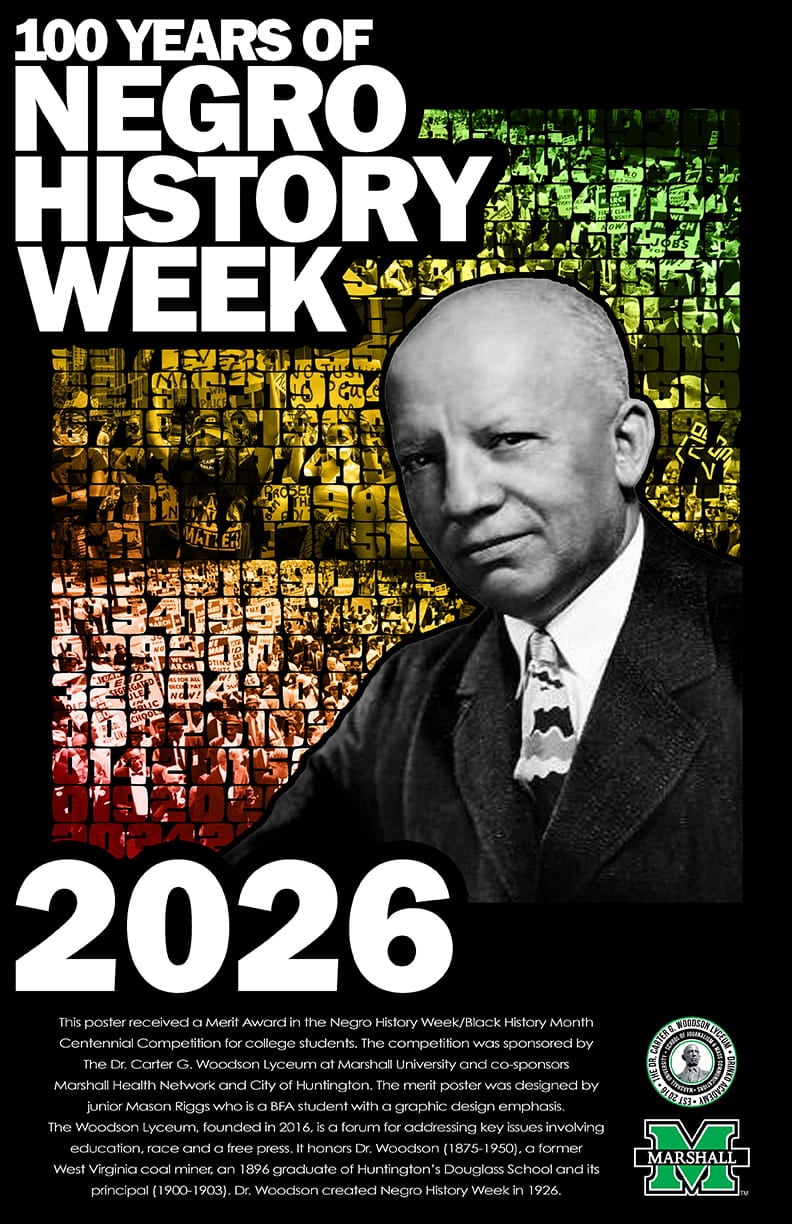
Merit Award
Mason Riggs
Marshall University junior, BFA, Graphic Design
Artists’ Statements
When presented with the opportunity to once again create a poster for Black History Month I was eager to get started. I was intrigued by the Centennial theme and the open-ended subject matter. When researching ideas and narrowing them down the choices, I decided on quilts and began ideation. I decided to incorporate all the past poster winners as a way to honor them and their history. After a conversation with my professor to make sure my idea was feasible, I went for it.
What shape and pattern should the quilt blocks be? I started researching quilt blocks and the meanings behind them. I was also thinking of not only the past but also the future of Black History, and what that could mean to those that view my poster. The quilt blocks would represent the past, so what could I use to represent the future. I used a little girl dressed in yellow, the color of safety and hope, to symbolize the future of Black History Month and possibilities that it holds.
Quilt blocks hold a profound place in African American history. Especially during the era of slavery and the Underground Railroad. Quilting was not only a creative expression but also a means of survival and communication. According to the Smithsonian Center for Folklife and Cultural Heritage, quilt patterns are believed to have served as coded messages to guide enslaved people toward freedom. The patterns that I have included in my design are just a few of those various designs. Bow tie, Shoofly, Monkey Wrench, Nine Patch, Bear’s Paw, Crossroads, Flying Geese, Drunkards Path, Log Cabin, Signature, and the Star have all have their place in my poster design.
1. Bow Tie may signal the need for a disguise or a change of clothing;
2. Shoofly signaled that a home offered help to escaping slaves;
3. Monkey Wrench is believed to be one of the first quilt codes signaling to gather the tools you need to escape;
4. Nine Patch is most commonly used for practicality, and as a basic quilt pattern, it was once a signal for slaves that there was a community garden on property;
5. Bear’s Paw signals a trail or path and is sometimes believed to signify a way through the wilderness or follow the bear tracks through the mountains to water and food;
6. Crossroads can either represent multiply paths or a specific destination with one example being Cleveland, Ohio as a key stop to freedom;
7. Flying Geese was used for direction and migration to point the way for slaves toward freedom;
8. Drunkards Path represents a winding, zigzag path, which could be used to show the need to take an indirect route;
9. Log Cabin symbolizes seek shelter now, and you are safe to speak with the people at this location;
10. Signature Patch is a signature of who made the quilt, or a message written on the quilt usually marked with a year;
11. Star is a signal to follow the North Star to freedom.
These quilts would often hang on the clothesline or the windowsill along the trail that represented the Underground Railroad. Women would gather to sew with their nimble fingers, working in secret, and armed with only a needle and thread. They were engaging in a visual language and doing their part to help slaves find freedom. All while creating a sense of community, an opportunity for storytelling, and cultural preservation. Each stitch carried meaning, linking generations through a shared history. Today these quilt blocks are a celebration of a shared history and future. During Black History Month these are symbols of ingenuity and courage. They remind us that art can be a powerful form of resistance and that creativity often flourishes under oppression. By studying these patterns that are so commonly used today, we honor the resourcefulness of African Americans who turned fabric into a language of liberation.
Work Cited
May 3, 2019 | Marie Claire Bryant | Comments. “Underground Railroad Quilt Codes: What We Know, What We Believe, and What Inspires Us.” Smithsonian Center for Folklife and Cultural Heritage, folklife.si.edu/magazine/underground-railroad-quilt-codes . Accessed 16 Nov. 2025.
The research I did during the creation process was mostly supplementary, as I was fairly confident in my ideas from the beginning. The first thing I learned when making the poster is what the color scheme of red, yellow, green and black represent. Though these colors have certainly been used for posters in the past, I believe they were the best choice to go with. I also learned that some individuals see it as disrespectful to
depict historical figures using unusual colors, which led to a correction being made in my design. The final thing I learned was that the font I was originally using for the header and year, Bauhaus 93, was created by an Austrian designer whose work had appeared in nazi galleries during WWII. I could not find any info on his own political stance, but I changed the font regardless to a non-controversial gothic font.
I decided to use an image of Dr. Carter G. Woodson because he started Black History Month, so he felt like a no-brainer to include. I used that particular image of him for two reasons: 1) It’s a lesser-used photo of him, 2) He is facing to the left of the frame. I wanted him facing the left because that can be used to represent looking back at the past, much like how this year is celebrating the past 100 years of Black history month. Another element that represents the past 100 years is the background, which consists of images of rallies from the Civil Rights and BLM movements that have been framed within tightly packed numbers. These numbers are the digits of every year from 1926 to 2026, and they have been colored red, yellow, and green within a black frame to further represent Black history month.