
Key Takeaways
- A master’s is the required entry point for new athletic trainers, and it leads to a licensed healthcare career that extends across many industries.
- Athletic trainers work across three broad setting types: traditional, clinical and emerging fields such as performing arts and public safety.
- Marshall’s 3+2 program saves time and money, letting students earn both degrees in five years and sit for the BOC exam a year early.
- The field is growing fast, with 11% projected growth through 2034 and a median wage of $60,250.
So you want to work with athletes, but you keep hearing that a bachelor’s degree alone won’t get you there anymore. That’s true, and it’s also the start of a bigger opportunity than most prospective students realize. A master’s in athletic training reaches well past a spot on the sidelines. Graduates treat performers, service members, factory workers and surgical patients, and they do it across schools, hospitals, clinics, military bases and corporate campuses.
If you’re considering this degree, you’re probably asking two questions: what can you actually do with it, and is the time and cost worth it? This guide answers both. We’ll walk through what a master’s in athletic training covers, the career paths it supports, where athletic trainers work, what they earn and how Marshall’s 3+2 program gets you into the field a year sooner than most competing programs.
What Is a Master’s Degree in Athletic Training?
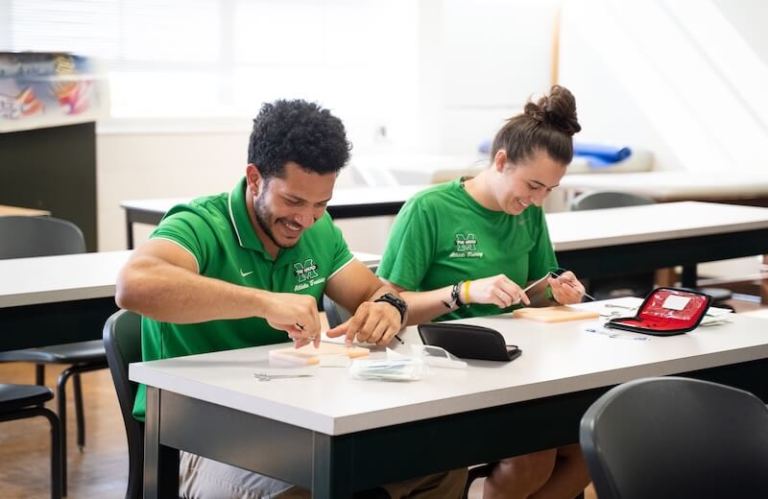
A master’s degree in athletic training provides students with knowledge, skills and experience in sports medicine, injury prevention, assessment, treatment and rehabilitation. The curriculum typically includes courses on human anatomy, human physiology, first aid and biomechanics, coupled with hands-on immersive clinical experiences and rotations that include working with local high schools and on-campus athletic departments.
Some programs may even require students to gain general medical experience, which could involve working with a family practitioner, in an emergency room or in orthopedic and physical therapy settings.
How Many Athletic Trainers Have Their Master’s Degree?
Approximately 70% of athletic trainers hold a master’s degree. This stems from a 2015 decision within the athletic training profession to require it for entry to the field, phased in through accredited programs by the Commission on Accreditation of Athletic Training Education (CAATE). However, professionals who were already practicing as athletic trainers with only a bachelor’s degree are not required to obtain a master’s degree to meet this standard.
In addition to national certification from the Board of Certification (BOC), many states also require their own licensing or certification mandates for athletic trainers.
Benefits of a 3+2 Program
Some colleges and universities offer a 3+2 athletic training program in which students spend three years in their undergraduate work followed by two years of a graduate program. This allows students to earn a bachelor’s and master’s in five years, as opposed to a traditional 4+2 program (four years of undergraduate study and two years of graduate education).
Benefits of a 3+2 program include:
- Time and cost efficiency: By obtaining both a bachelor’s and master’s degree in just five years, students can save time and money by earning graduate credits at a discounted rate and moving on an accelerated path to certification.
- Seamless transition from an undergraduate program to graduate curriculum: A 3+2 program has a consistent curriculum and is designed with a smooth transition between programs, often allowing students to start specializing in their field of interest earlier than if they were in a 4+2 program.
- Early clinical exposure: This allows students to engage in hands-on learning earlier in their educational journey.
- Reduced time in the job market: Students in a 3+2 program can enter the workforce sooner, which is especially important given that athletic training jobs are growing much faster than average. BLS projects 11% growth through 2034, compared with 3% for all occupations.
Required Certifications to Become an Athletic Trainer
The athletic trainer requirements are consistent across most of the country. To become an athletic trainer, you must graduate with a master’s degree from an accredited professional athletic training program and then pass a comprehensive test administered by the BOC. This allows you to become licensed in the state in which you intend to practice.
Once you have obtained certification, you must meet ongoing educational requirements to remain certified. The Athletic Trainer Certified (ATC) credential and the BOC requirements are accepted in 49 states (plus the District of Columbia) as meeting the qualifications needed to work as an athletic trainer.
Some positions or industries may require additional certifications, examples of which include:
- Sports Manual Therapy Certification (SMTC) from the Institute for Athlete Regeneration.
- Instrument Assisted Soft Tissue Manipulation (IASTM) certification from Graston Technique or HawkGrips.
- Blood Flow Restriction certification through either Owens Recovery Science or Smart Tools.
- Dry needling certification, available through numerous avenues, such as the Myopain Seminars Dry Needling Certification Program, the Integrative Dry Needling Institute and the American Academy of Manipulative Therapy.
- Certified Strength and Conditioning Specialist courses from the National Strength & Conditioning Association (NSCA), recommended if you’re working in or responsible for strength and conditioning programs.
Corrective Exercise Specialist from the National Academy of Sports Medicine (NASM), ideal if you are working in rehab. - Functional Movement Screen (FMS) and Selective Functional Movement Assessment (SFMA) courses from Functional Movement Systems. FMS and SFMA courses 1 and 2 can be completed either online or in person.
Who Should Pursue a Career in Athletic Training?
Are you wondering if a career in athletic training is right for you? People considering this role often possess some or all of the following qualities:
- Passion for sports and athletics, fitness or medicine
- Interest in helping athletes or professionals prevent and recover from injuries
- Ability to handle high-pressure situations involving severe injuries and medical emergencies
- Organizational skills, attention to detail and teamwork
- General interest in sports medicine, anatomy, physiology and rehabilitation techniques
Overview of Athletic Training Responsibilities
The National Athletic Trainers’ Association (NATA) defines athletic trainers as “highly qualified, multi-skilled health care professionals.” They are trained in preventative services, emergency care, clinical examination and diagnosis, therapeutic intervention and rehabilitation of medical conditions and emergent, acute and chronic injuries.
Athletic training is recognized as an allied health care profession by the American Medical Association, the Health Resources and Services Administration and the Department of Health and Human Services.
Dr. Zach Garrett, the director of Marshall University’s Athletic Training Program, explains that while athletic trainers have a wide range of responsibilities, some of the most satisfying days are the quiet ones, when practice goes smoothly.
“The best days are when nothing happens,” Garrett said. “If I just have to watch practice, that’s a win. You never know what you’re going to see. You have to be prepared. When someone goes down on the field, it could be a knee injury or a cardiac emergency. Students who want to help others in a unique environment are often driven to this kind of program and career.”
Typical duties include:
- Applying injury-preventative devices, such as tape or braces
- Providing on-site emergency care and coordinating with doctors and EMS officials
- Developing a rehab program for an injury
- Planning preventative programs to prevent injuries
- Offering educational programs
Performing administrative tasks such as ordering supplies and writing reports
Where Do Athletic Trainers Work? Career Paths and Work Environments
Athletic trainers turn up in far more places than a sports field. The same skills that keep an athlete healthy apply anywhere people push their bodies and risk injury, which is why you’ll find certified athletic trainers in clinics, factories, theaters and on military bases. The settings below fall into three broad categories, and the day-to-day work shifts with each one.
Traditional & Educational Settings
These are the environments most people picture first, where athletic trainers support active athletes across every level of competition.
- High schools and secondary schools: Provide on-field coverage during practices and games, respond to emergencies and manage injury care for teen athletes.
- Colleges and universities: Handle daily healthcare, rehabilitation and travel logistics for collegiate student-athletes across multiple sports.
- Professional and Olympic sports: Travel with elite teams and organizations to manage high-level performance, recovery and return-to-play decisions.
Clinical & Healthcare Settings
Here, athletic trainers work alongside physicians and therapists as part of a patient’s broader care team.
- Physician practices: Assist orthopedic doctors and surgeons with patient intake, casting, bracing and clinical assessments.
- Hospitals and rehabilitation clinics: Support physical therapy, therapeutic interventions and post-operative recovery plans for patients well beyond competitive athletes.
Nontraditional & Emerging Settings
The National Athletic Trainers’ Association groups these newer workplaces under its “emerging settings” framing, and they’re where much of the profession’s recent growth is happening.
- Industrial and corporate: Consult on workplace ergonomics, injury prevention and first aid for manufacturing and commercial workforces.
- Tactical and public safety: Partner with police academies, fire departments and military installations to keep service members and first responders fit for duty.
- Performing arts: Treat dancers, musicians and touring theatrical performers for the physical strain and movement injuries their work creates.
Marshall’s own graduates reflect this range. Recent Professional Master of Science in Athletic Training graduates have found work in high school, college and professional athletics, outpatient clinics, industrial rehabilitation sites, physician practices, the performing arts, military and safety settings and higher education.
What Athletic Trainers Earn
Pay varies with the employer, industry, location and years of experience. According to the U.S. Bureau of Labor Statistics, the median annual wage for athletic trainers is $60,250, with the highest 10% earning more than $84,100. Employment is projected to grow 11% through 2034, well ahead of the 3% average across all occupations. Marshall notes that among athletic training fields, the highest salaries tend to be in the performing arts and professional sports.
Top Reasons for Earning a Master’s Degree in Athletic Training
While a master’s degree is now required to become an athletic trainer, an advanced education offers benefits beyond meeting that standard, including deeper clinical experience and valuable networking opportunities.
Benefits of earning a master’s in athletic training include:
- Increased knowledge: A master’s degree program helps you develop stronger expertise in injury prevention, rehab techniques and sports medicine.
- Expanded professional network: Builds connections with faculty, peers and other professionals in the industry, all of which can lead to important opportunities and collaborations.
- Research experience: Helps you gain knowledge by working on advanced research projects.
Ready to Learn More About Marshall’s 3+2 Athletic Training Education
Marshall University is one of two institutions in West Virginia to offer a 3+2 athletic training program, which lets students sit for the BOC exam a year earlier than peers in competing programs while reducing tuition costs. That combination makes Marshall one of the most affordable athletic training programs in the country, even for out-of-state students.
Students train under BOC-certified athletic trainers, physicians, physical therapists and other healthcare professionals throughout their clinical rotations, building the supervised hours the credential requires.
The Marshall University Professional Master of Science in Athletic Training (PMSAT) Early Assurance Program (EAP) also lets high school seniors, in-state or out-of-state, apply for conditional acceptance into the master’s program before they arrive on campus.
If you have questions or want more detail, visit the Athletic Training B.S.-to-M.S. program page or request more information.
FAQs
The difference between an athletic trainer and an exercise physiologist comes down to what each one treats and how they’re credentialed. Athletic trainers are licensed healthcare providers who prevent, assess and treat injuries, often on-site and in real time. Exercise physiologists design fitness and exercise programs that improve health or manage chronic conditions such as heart disease or diabetes, usually in a clinical or office setting rather than on a field. Athletic trainers hold the ATC and a state license, while exercise physiologists typically enter the field with a bachelor’s degree.
Whether a master’s in athletic training is worth it depends on your goal, though for anyone who wants to practice, it’s now the required entry point. Beyond meeting that standard, the degree qualifies you for a licensed healthcare profession with strong projected job growth, and an accelerated program can lower the total cost of getting there. Students weighing the investment should compare program length, tuition and how early each program lets you sit for the BOC exam.
Besides working with sports teams, a master’s in athletic training qualifies you for roles across healthcare and industry, because these skills transfer to any field where people strain their bodies. Certified trainers increasingly work in occupational health, public safety and healthcare administration. Some also move into adjacent allied-health roles, such as physical or occupational therapy, though those paths require additional graduate education and separate licensure.
The athletic training settings that tend to pay the most vary with industry and location, which the profession-wide median doesn’t capture. Among the top-paying industries for athletic trainers, BLS reports that arts, entertainment and recreation lead the list, followed by educational services and hospitals. Experience, region and setting all move the number well above or below the median.
No, athletic trainers don’t need a doctorate to advance in their careers because a master’s degree and BOC certification are enough to practice and to move into head athletic trainer or clinic administration roles. A doctorate mainly benefits those aiming to teach at the university level or lead research, so most practicing athletic trainers advance through experience and specialized certifications rather than another degree.