
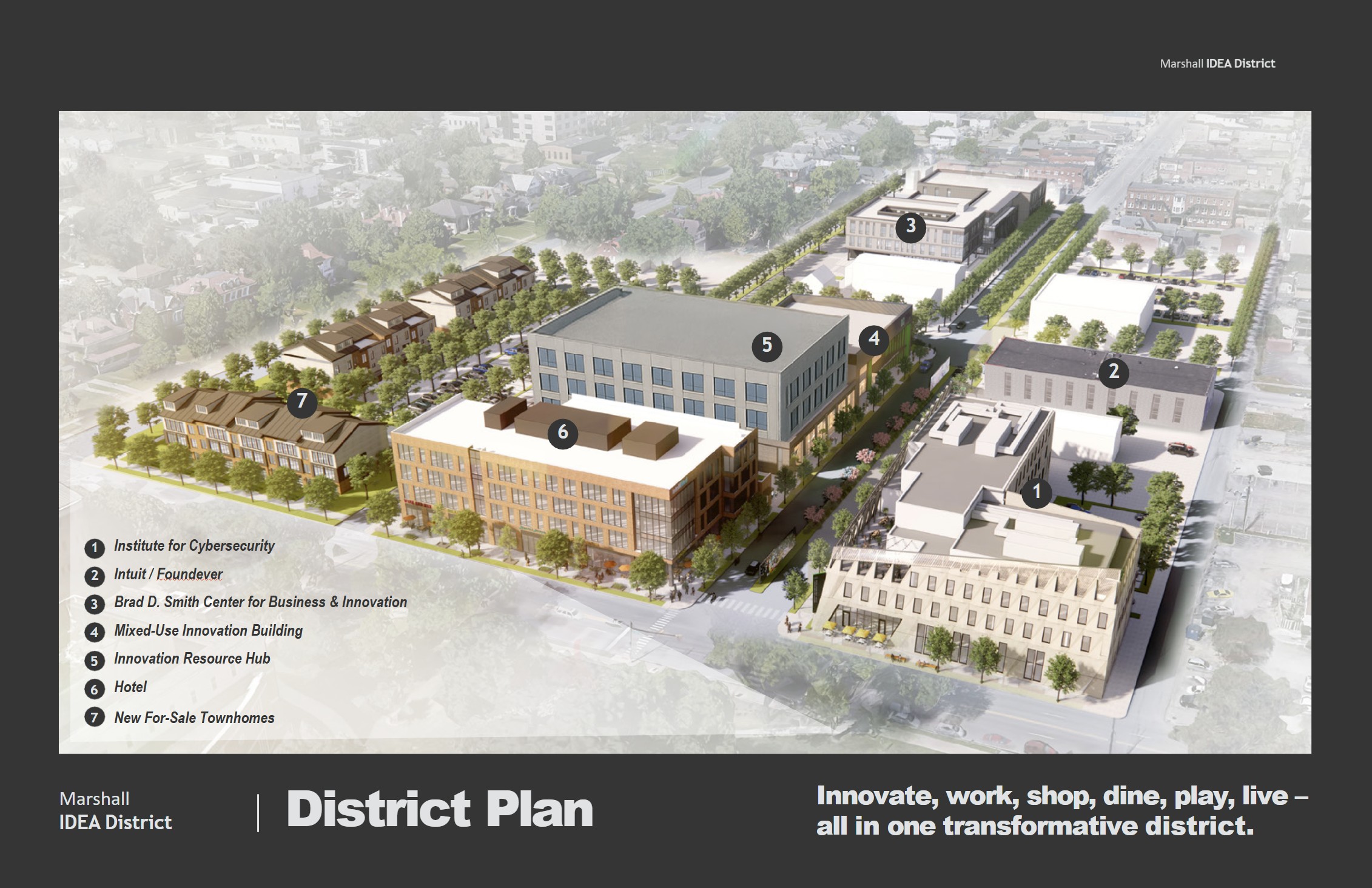
Originally introduced as the Innovation District, the IDEA District is anchored on one end by the university’s $45 million Institute for Cyber Security, currently under construction at 4th Avenue and Hal Greer Boulevard. On the opposite end stands the Brad D. Smith Center for Business and Innovation, creating a powerful corridor of academic excellence and industry partnership.
Designed to serve as a hub for collaboration between academia and industry, the IDEA District will support cutting-edge research, foster new business ventures and stimulate long-term economic growth. University leaders say the district is poised to help propel West Virginia into a new era of sustainable economic advancement.
“The IDEA District represents a bold step forward for Marshall University and for the entire state of West Virginia,” said Brad D. Smith, president of Marshall University. “By bringing together these elements in one vibrant space, we are creating an environment that will attract talent, fuel new ventures and strengthen our regional economy for generations to come.”
Huntington Mayor Patrick Farrell said the development of the IDEA District further strengthens an already strong partnership.
“As Marshall gets involved and the city gets involved, things begin to happen,” Farrell said. “We don’t do it alone. We do it with cooperation from our county, from our state partners and our federal partners, because none of us can do it alone. When we work together, across the university, the city, the state and the feds, we can make things happen and we can solve our own problems. All of this is an investment in our community.”
The development also includes the central section, currently occupied by companies like Intuit and Foundever, which already have provided well-paying jobs for student interns, as well as a planned presence by RGEN, an innovative genomics research company.
Toney Stroud, Marshall’s vice president for strategy and corporate relations, said RGEN is partnering with Marshall University and the West Virginia Forensic Investigative Genetic Genealogy (FIGG) Commission to provide answers to unsolved deaths in West Virginia.
“Marshall has one of the top forensics science programs in the country,” Stroud said. “The goal long-term is to have a genomics center right here, a physical space, in this district.”
Stroud said that thus far, the RGEN and FIGG project has successfully identified 52 human remains of the 79 pending cases, providing closure for dozens of families across the Mountain State.
“Marshall’s IDEA District creates exactly the type of ecosystem where breakthrough science can drive real-world impact,” said Jaime Raijman, co-founder and CEO of REGN, Inc. “Through RGEN Inc.’s partnership with Marshall and the FIGG Commission, we are jointly bringing advanced genomic capabilities to West Virginia to support public safety, accelerate innovation, and contribute to the state’s long-term economic growth. We’re proud to be part of the development of programs that are reshaping biotech capabilities at Marshall University and across West Virginia.”
The FIGG Commission is a collaborative effort among the West Virginia State Police, West Virginia State Police Forensic Laboratory, Office of the Chief Medical Examiner, Marshall University Forensic Science Center, West Virginia Fusion Center, West Virginia Prosecuting Attorney’s Institute and West Virginia Intelligence Exchange. Together, they are working to advance forensic genetic genealogy to identify the unknown, solve cases and bring answers to families across West Virginia.
Additional development partners for the district are expected to be announced in the coming months through the coordinated efforts of Fairmount Properties, the city of Huntington and the state of West Virginia.
Construction on the ICS began in November and is expected to be completed in the summer of 2027.
C.R. Neighborgall with Neighborgall Construction said the next 18 months will include major structural work, interior build-out and installation of advanced cybersecurity infrastructure for the $45-million, state-funded project.
“It was at a breakneck pace that we started this project,” Neighborgall said. “Due to the cooperation of all the stakeholders, we’ve been able to move very quickly. What you see happening right now is deep foundation work, so that crane you see is going down 60 feet in the ground and we will have 247 drilled piers. Steel erection will start in February and precast panels in August and we hope to be under roof in October and be finished by July of 2027.”
Neighborgall said about 100 workers are involved in the project.
Plans for the IDEA District also include a boutique hotel brand and residential housing for professionals, as well as retail and dining services, like Via Lombarda, a Mediterranean-style market by Huntington restauranteur Ralph Hagy and his family. Hagy, who founded La Famiglia on 6th Avenue, will operate the eatery, which will be located on the ground floor of the Institute for Cyber Security.
Additional updates on construction progress and upcoming project milestones will be shared as development continues.
Media assets from today:
http://bit.ly/49dBCVl (Video download)