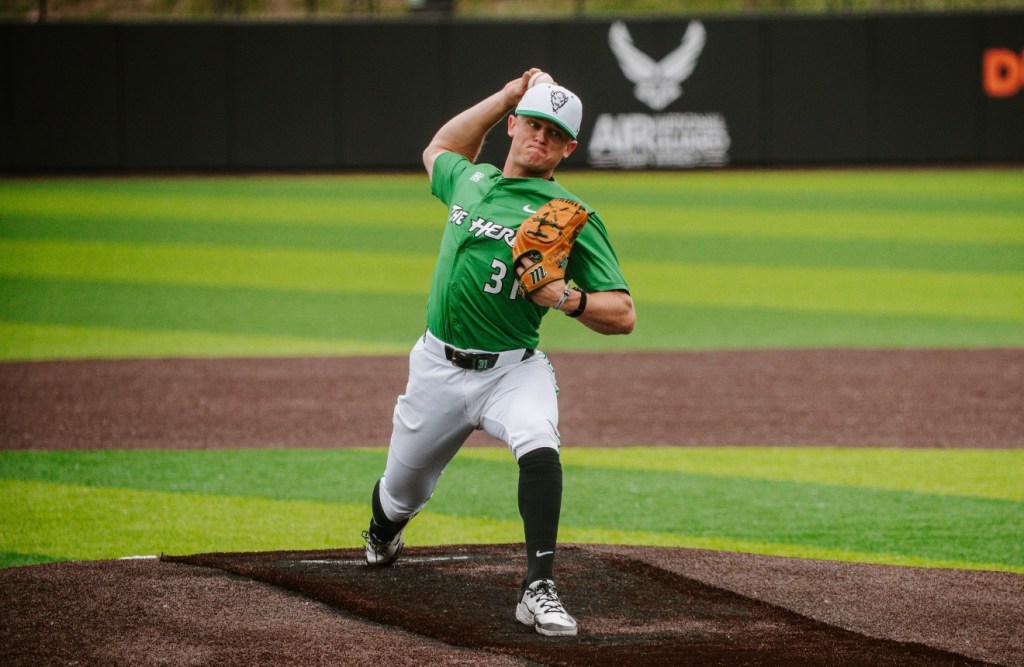
A gentleman sitting in row three behind home plate was more exuberant, with a yell and a fist pump. Moments later, Rodney May stood with the rest of the crowd at Jack Cook Field and gave Collins a standing ovation. Final score: Marshall 3, Butler 1.
May knew something that the Thundering Herd pitcher didn’t: Collins had just broken his grandfather’s record.
“Later on, I got a message from Pawpaw and a picture of the newspaper story,” Collins said. “He’s a humble guy and doesn’t talk a lot about what he did at Marshall, but he sent me that.”
The photo was of Marshall’s Parthenon from April of 1969, an article detailing sophomore Rodney May’s school-record 13 strikeouts during a 5-1 win over West Virginia State.
“It makes me so proud to watch him compete,” May said. “I loved to pitch and had a lot of confidence in myself, but it’s more exciting for me to watch him excel than when I was doing it myself.
“It’s the cliché, but records really are made to be broken. Even better when it’s my grandson.”
The May/Collins Marshall family tradition took root in the mid-1960s when May’s Barboursville Pirates played against the Huntington High Pony Express and Coach Jack Cook.
“My junior year, I threw two one-hitters against Huntington, but we lost both games,” May said. “Then Coach Cook took the Marshall job. He recruited me when I was a little left-hander who weighed 135 pounds and didn’t throw hard enough to break an egg.”
Before long, May was pitching against future Major Leaguers like Ohio University’s Mike Schmidt, as Coach Cook built a competitive program despite limited resources – including a home field at St. Cloud Commons that seemed to be under water as often as not.
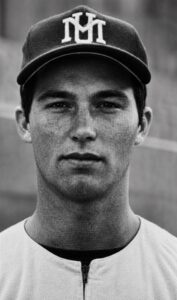
“The river would flood, and people were catching fish in our outfield,” May said. “I watch a ground ball at the new park taking true hops and shake my head. You never got the same bounce twice at St. Cloud. Just be ready for anything.”
“I played Babe Ruth games at St. Cloud,” Collins said. “It’s hard to believe they played college baseball there.”
The ballpark wasn’t the only difference in college baseball 50-plus years ago. For instance, the idea of a “pitch count” wasn’t yet around.
“We had no idea how many pitches we threw,” May said. “Nobody kept track.
“I always started the first game of the series and I might throw 100 or 120 or however many pitches in a complete game.
“Then Coach Cook would come up to me and say, ‘How do you feel, Rodney May?’ He never called me just Rodney or just May, it was always Rodney May. ‘Can you give me a couple of batters in Game Two, Rodney May? Can you give me an inning tomorrow, Rodney May?’
“Of course, I did it.”
As a senior in 1971, May set school records of eight wins, 72 strikeouts and 100 innings pitched. His earned run average was 2.34. Marshall played only 35 games that season – he was on the mound for more than one-third of the team’s total innings.
That season was played while the Marshall campus was mourning the loss of the football team the previous November.
“It was so devastating to all of us to walk back on campus and those guys weren’t here,” May said. “Funerals going on everywhere. I still get misty-eyed when I think about it. They were just kids. Ted Shoebridge played baseball with us for a year.”
Rodney married Susie Morris, also a Marshall student. They both became Cabell County teachers and by 1976, he was the Barboursville High School baseball coach.
They began raising a family – daughters Bonnie, Jennie and Katie, and son Lee.
The May house was filled with sports and competition.
“Susie would tell me, ‘Rodney May, you’re two different people,’” May said. “She called me Rodney May just like Coach Cook did.
“She’d say ‘You’re always so cool and calm, until it’s a competition.’
“It’s true. If we’re playing a board game, we all want to win. If we’re playing Monopoly and you run out of cash, that’s it. You’re done. I’m not loaning you money.”
The competitive spirit naturally led to the ball fields and courts.
Lee went on to play college baseball at West Virginia State. Bonnie married former Marshall football player Will Edwards.
Jennie became the first girls’ basketball player to score 1,000-points at the new Cabell Midland High School after Barboursville and Milton consolidated. She married Tim Holmes, a former Kentucky football player. Their family includes Brennan, an all-state baseball player at Cabell Midland, who went on to play at Shepherd University, and Ryan, who became the captain of the Marshall soccer team for Coach Chris Grassie.
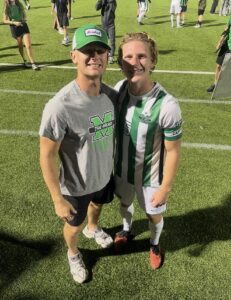
Katie married Curtis Collins, the first 1,000-point scorer in Cabell Midland boys’ history, who went on to play college basketball at Rhema Bible College in Oklahoma. Their son Kenyon fit right in with his competitive aunts and uncles and cousins.
“One of my earliest memories of wanting to win something is when we’d get together at Easter, and we’d do an egg toss,” Collins said. “It was a big deal to win it.
“Whenever we were together, we were playing something – basketball, football. We had epic whiffle ball games in Pawpaw’s back yard. Even the cousins who didn’t go play in college were good athletes and played high school sports.”
Collins’ childhood also included a strong dose of the Herd.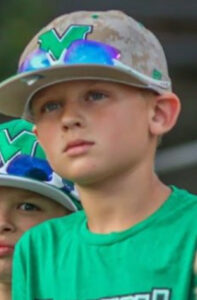
“The first thing I remember about Marshall is going to football games,” he said. “Mainly what I remember is my family and my buddies hanging out and tailgating before the games, just having a good time, throwing a football around out in the parking lot.”
From early on, Rodney knew that the family had another athlete. Kenyon was a member of an Ona Little League team that won the West Virginia State Championship. His teammates included Michael Lunsford and Jared Nethercutt, sons of former Marshall football players Bubby Lunsford and Curt Nethercutt.
Several members of that Ona team stayed together to help Cabell Midland win back-to-back state championships in 2023 and 2024.
The Knights’ pitching coach was Rodney, who was enticed back to help after stepping away when Lee graduated from high school and went on to play in college. The return gave May the opportunity to coach three of his grandsons.
“Pawpaw didn’t push me as a pitcher when I was younger,” Collins said. “But when he was my pitching coach in high school, that’s when I learned from him. When I decided to take pitching seriously, he was right there for me.”
College recruiters came calling. Family and history won out.
“Coach Cook’s daughter, Kim, brought me down here when they were still building the new park,” said May. “She said, ‘You and Kenyon come down here and see it.’
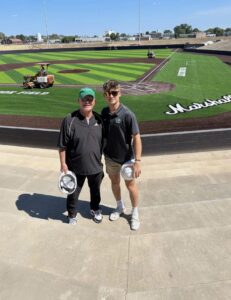
“I walked in and thought, ‘What a dream to play baseball here,’ and Kenyon decided to do it.”
“This is home,” Collins said. “Jack Cook Field is 15 minutes from my house.
“All of my family has Marshall ties – they went to school here or had kids who did. Everybody is a Marshall fan and supporter. It’s really cool that Ryan and I have been able to be a part of the Marshall and Thundering Herd sports family.”