
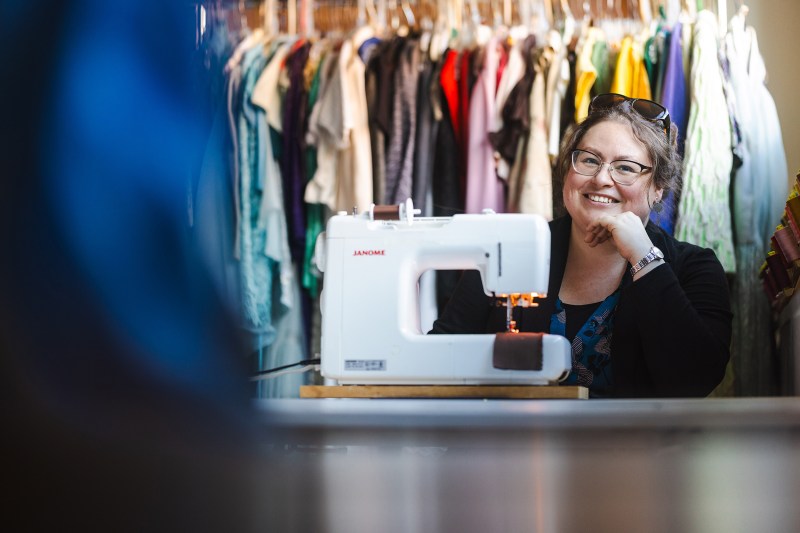
Olivia Trees is always diving into different realms.
As an assistant professor of costume design and construction in Marshall’s School of Theatre & Dance, she’s a key player in creating the magic that happens onstage.
One season, she and her students built costumes for characters who were under the sea, and in another, costumes for characters competing in a children’s spelling bee. In one of their more difficult challenges, they made costumes for a show in which the main character was fighting monsters in a fantasy realm, and in yet another, the characters were simply navigating life in smalltown America in the early 1900s.
And the list goes on.
Every theater season brings at least four unique worlds to explore through fabric and whatever materials she can find. But this fall, Olivia and her students pitched in to help with a side project like they’ve never done before.
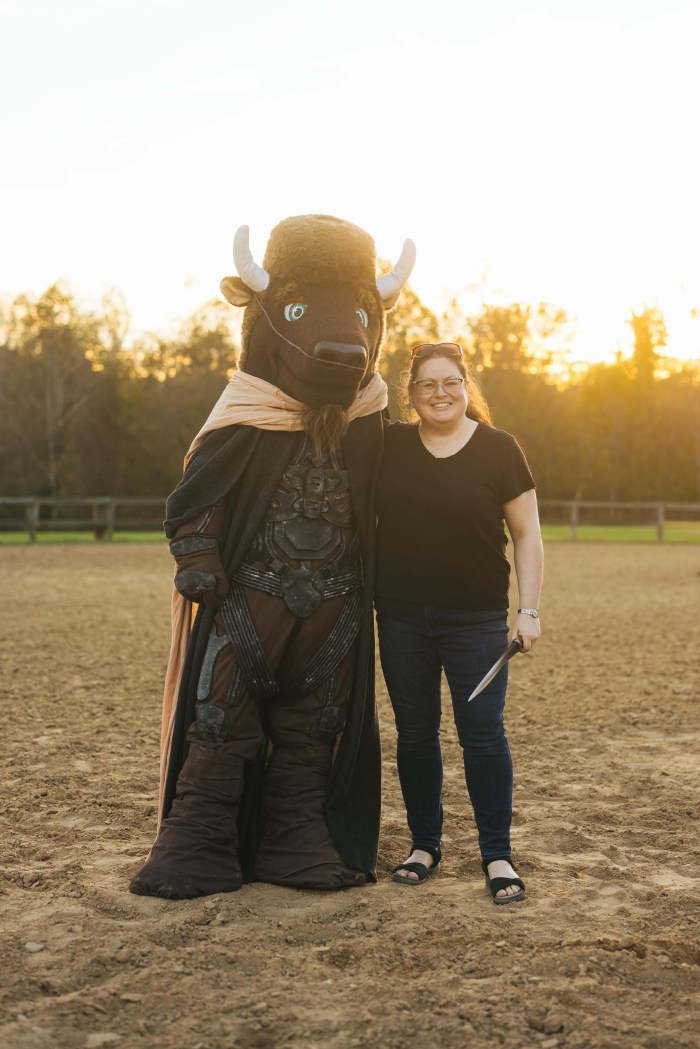
They turned Marco into a futuristic warrior from “Dune” — which is not a costume you can find on amazon, not in a mascot size, anyway. It was upon request from Marshall’s marketing department, for the purposes of a fun, Halloween photoshoot, and Olivia wasn’t about to turn down the unique opportunity.
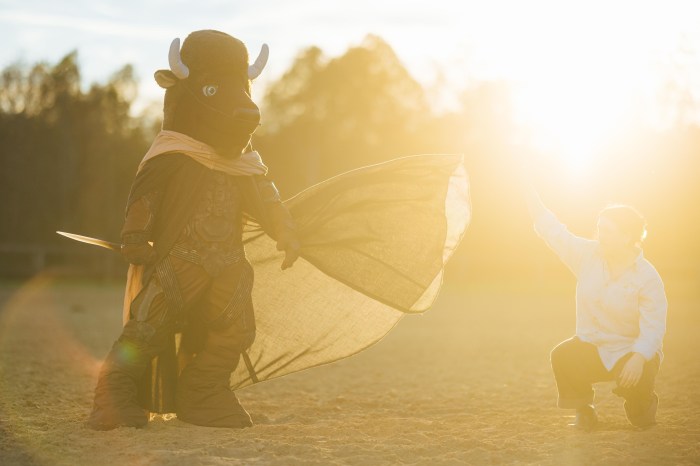
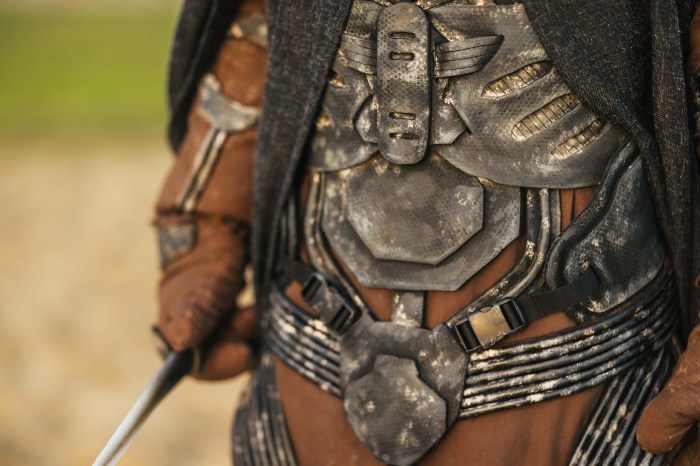
She took the measurements — the largest head and strangest foot shape she’s ever measured. She scoured the internet until she found an online pattern for the specific Dune armor. She watched the movies to see how the armor looks standing still, and how it moves. She found the materials, which included everything from some curtains for the cloak and a yoga mat to cut up to create the armor. She also got her students involved (Somy Slonaker, Emily Stewart, Jacob Gillispie and Briar Conley), because she knew it would be a unique learning opportunity.
And they got to work.
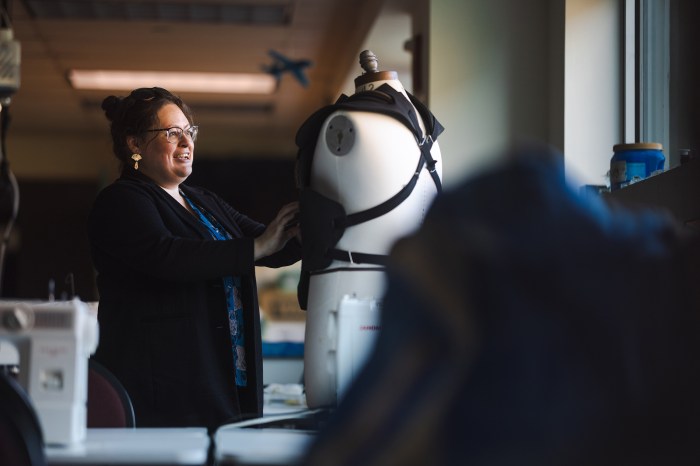
“It’s been fun – I’m getting really into it,” Olivia said as the construction process was just getting started. “I’m excited to dig into getting armor put together. I’ve been collecting materials and trying to think through the plan for the last several days. Now it’s the scary moment of starting — cutting into the fabric and cutting into the foam. Then it will be fine.”
It’s a stressful moment that she experiences quite often as the chief costume creator for the university and its productions, but one that keeps the job exciting, which is what she loves best about the work.
There’s always a new adventure the next day. I might be frustrated. I might be angry. I might be elated. I might be all kinds of emotions, but I don’t often get bored with this job. There’s always a new challenge.
— Olivia Trees
Olivia came to Marshall in the spring of 2019 by way of New York City, after earning her bachelor’s degree in theater from Florida State and her master’s in costume design from the University of Tennessee, Knoxville. In New York, she worked in different costuming positions, including jobs with Euroco Costumes and The Julliard School.
At one point, she connected with John Colclough (also known by his stage name, Jack Cirillo), director of Marshall’s School of Theatre & Dance, who was working temporarily on a show in the city during a sabbatical. The production company in Queens had ties with a Marshall alum.
“He was acting in a production of ‘Much Ado About Nothing’ by Shakespeare, and I became the designer on that show because of somebody I met in graduate school — they had lost their (costume-designer) and asked me if I was available,” Olivia said. “I threw that together for them, and several months later, here at Marshall, they called and asked if I was available because they needed somebody for the spring.
“That’s one of the things I enjoy about this kind of work,” she said. “I’m never bored. I like to travel. I like to go on this journey of, ‘Let’s see what’s next. Let’s find out who else I can meet and what other projects I can work on.’ I’ve been here for almost eight years.”
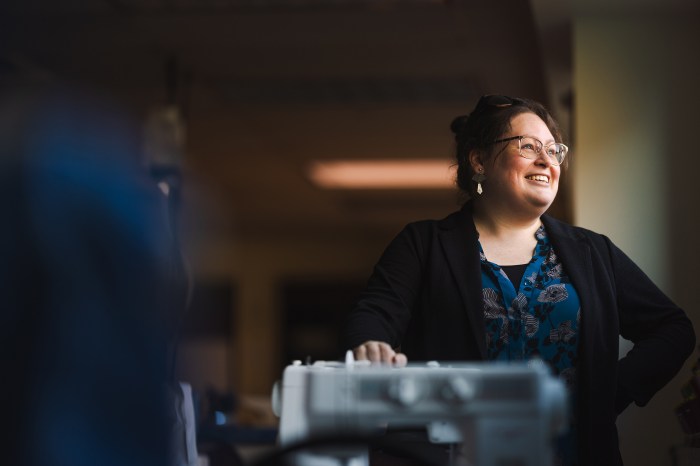
The adventures have continued here at Marshall, which not only provides a supportive atmosphere for the arts but also an amazing space for doing her work at the Joan C. Edwards Performing Arts Center, said Olivia, who grew up in Illinois and Florida, in a household full of color and creativity.
“The environment around here, even the university at large, is one of positive growth,” she said. “Artists don’t always know what’s coming next, which is both exciting and a little scary. So far, it’s a very positive environment, and my shop is one of the best costume shops I’ve ever seen. Most of them are in an underground, windowless basement, and I have a full wall of windows and plenty of space. I have a whole separate laundry and craft room. I have stock rooms. I’m in a very lucky place here.”
She teaches things like costuming (which involves hand and machine sewing), costume design, stage makeup, and construction.
Olivia said she’s fortunate to be surrounded by an amazing team, not only amongst theater department faculty, but in her students, who sometimes walk into her “Intro to Costuming” class not knowing how to use a sewing machine, but leave with a remarkable new skillset.
In that first class, the first thing they do is make a shirt.
“They often come in very scared at the beginning of the semester, very unsure and afraid of messing up,” she said. “They’re afraid of ruining the whole thing. Through the weeks, they bond together. They form a friendship and family — a team environment — on their own. And they help each other.
“Then by the end, they can sit down, use the machine without being terrified of it. They know the nuance of how it works. When something goes awry, they can help fix it.”
They become problem-solvers, which she hopes translates to every area of their lives.
Their projects also involve a lot of research on the front end, Olivia said.
I am a massive nerd all around, but I am a major research nerd.
— Olivia Trees
By research, she means everything from studying the script to watching online videos to reading books to asking experts to learn about the backdrop of any given story — the time period, the culture, the styles, and so on.
She also goes on a hunt for materials that can look right, but work realistically onstage. For example, Marco’s “Dune” armor was foam from a yoga mat, made to look distressed, like it’s been through some battle.
“I’m also looking for texture, shape, color, some crazy construction detail that would be interesting,” she said. “Then I dive into books or videos about how somebody created this really cool thing — and then, ‘How can I take that and apply it to our circumstances?’ It’s a big, wide world.”
The biggest challenge is always getting it done on time and within budget.
“I always have big dreams — trying to keep them relatively realistic is the challenge,” she said. “There is a deadline, and you can’t go past the tech opening, the photograph deadline.”
But she hopes the audiences enjoy the outcome and walk away not only having been entertained, but learning something and maybe wanting to explore further.
And she hopes her students walk away from the experience with some skills that will apply to careers in any field.
If our students stay in theater, that’s great. If they go into anything else, I hope that they’ve learned a sense of curiosity, teamwork, problem-solving, how to research something and put a presentation together. Being curious and asking questions is a big part of what I’m trying to pass on to students.
— Olivia Trees

More Moments
 Moments
Building a Future in Cybersecurity
October 27, 2026
Read Story
 Moments
From Marshall University to San Antonio: A Bell Honors Navy Veterans
October 21, 2026
Read Story
 Moments
A Head Start Without Debt
October 13, 2026
Read Payton's Story
 Moments
Prepared for Anything
October 5, 2026
Read Nathan's Story
 Moments
A helpful hobby turned into a successful career
September 29, 2026
Read Corey's Story