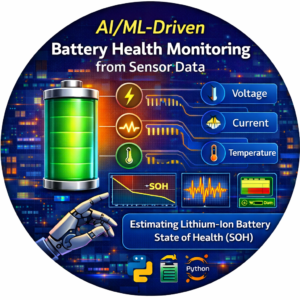
AI/ML-Driven Battery Health Monitoring from Sensor Data
This project focuses on developing data analytics and machine learning models to estimate lithium-ion battery State of Health (SOH) using publicly available battery aging datasets. Students will work with battery signals such as voltage, current, temperature, and charge/discharge cycle data to build predictive models and compare their performance under realistic operating conditions. The project is well-suited for students with basic Python programming skills and an interest in data analytics, machine learning, and engineering applications. Familiarity with data cleaning, plotting, spreadsheets, and basic statistics will be helpful. Students from computer science, data science, electrical engineering, and related fields are encouraged to apply.
Faculty Mentor: Dr. Yousef Fazea
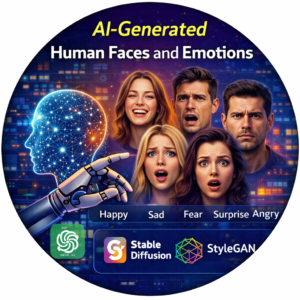
AI-Generated Human Faces and Emotions
AI-Generated Human Faces and EmotionsThis fun and exciting project introduces students to cutting-edge Generative AI by exploring how to create realistic human faces, such as happy, sad, fear, surprise, and other emotional expressions. Students will work with advanced models such as Stable Diffusion and StyleGAN, along with prompt engineering techniques inspired by GPT-4, to generate synthetic datasets for emotion analysis. The project provides hands-on experience in AI model usage, data generation, and analytics, allowing students to explore how modern AI systems can simulate and analyze human emotions. Why this matters today: Emotion-aware AI is rapidly becoming essential across industries such as healthcare (mental health monitoring), cybersecurity (behavior and threat analysis), education (adaptive learning systems), and human-computer interaction. There is a strong and growing demand from government agencies, research labs, and leading technology companies for professionals skilled in Generative AI, synthetic data, and emotion analytics. This project equips students with practical, in-demand skills in these emerging areas, preparing them for future careers in AI and data science.
Faculty Mentor: Dr. Haroon Malik
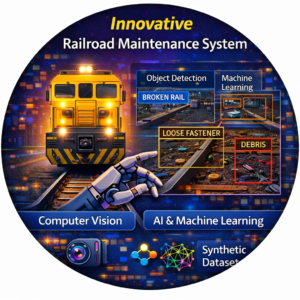
Innovative Railroad Maintenance System
Are you excited about transforming the future of transportation? In this innovative REU project, we aimed to create a maintenance warning system for railroads using cutting-edge computer vision and object detection technologies. This project offers a unique opportunity for undergraduate students to apply their machine learning and computer vision skills to a real-world problem that impacts safety and efficiency in the railway industry. By participating in this project, you will gain hands-on experience, collaborate with experts in the field, and contribute to pioneering solutions that could revolutionize railroad maintenance. Don’t miss the chance to be part of a team driving technological advancements. Apply now and make a tangible difference!
Faculty Mentor: Dr. Husnu Narman
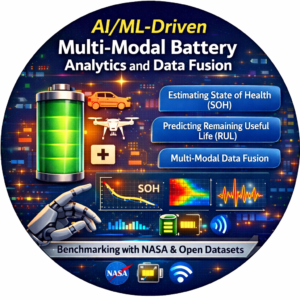
AI/ML-Driven Multi-Modal Battery Analytics and Data Fusion
Lithium-ion batteries are foundational to electric vehicles, drones, medical devices, and grid storage. Yet, their performance degrades in ways that are difficult to forecast reliably, especially under changing temperatures, charging rates (C-rates), and duty cycles. This REU project will develop and rigorously benchmark a reproducible data analytics + AI/ML pipeline to estimate State of Health (SOH) and, when feasible, Remaining Useful Life (RUL) using publicly available datasets (e.g., NASA aging datasets and other open benchmarks). Students will analyze contact signals and contactless/non-invasive indicators, with the emphasis on analytics and robust generalization rather than data collection or database construction; specifically, the work will enforce leakage-free evaluation (e.g., split-by-battery), quantify dataset shift across operating conditions, and investigate multi-modal data fusion (early fusion and ensemble/stacking) to improve prediction stability for practical monitoring and deployment. A core deliverable is a conference-ready research paper grounded in the benchmark results.
Faculty Mentor: Dr. Yousef Fazea
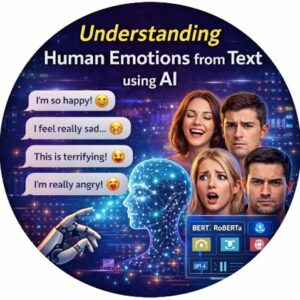
Understanding Human Emotions from Text using AI
In this project, you will explore how Artificial Intelligence can understand human emotions from text using modern Natural Language Processing (NLP) techniques. You will work with real-world textual data such as social media posts, reviews, and conversational datasets to identify emotions including happiness, sadness, fear, anger, and surprise. You will gain hands-on experience with state-of-the-art AI models such as BERT and RoBERTa, as well as prompt-based techniques inspired by GPT-4. You will learn how to preprocess text data, apply pretrained models, fine-tune them for emotion classification tasks, and evaluate model performance using standard metrics. In this project, you will work through the complete data analytics pipeline, including data collection, cleaning, model development, analysis, and interpretation of results. You will also explore how language reflects emotional context and how AI systems capture subtle cues such as tone, phrasing, and ambiguity. Why this matters today: Emotion analysis from text is widely used in healthcare, cybersecurity, social media, and customer experience. Major companies such as Amazon, Google, and Microsoft use these techniques to analyze customer feedback, improve user experience, detect harmful content, and build smarter AI systems. In this project, you will develop practical skills in AI and data analytics that are in high demand across industry and research.
Faculty Mentor: Dr. Haroon Malik