
COEPD Assessment, Improvement, and Impact
Marshall University Vision
To inspire learning and creativity that ignites the mind, nurtures the spirit, and fulfills the promise of a better future.
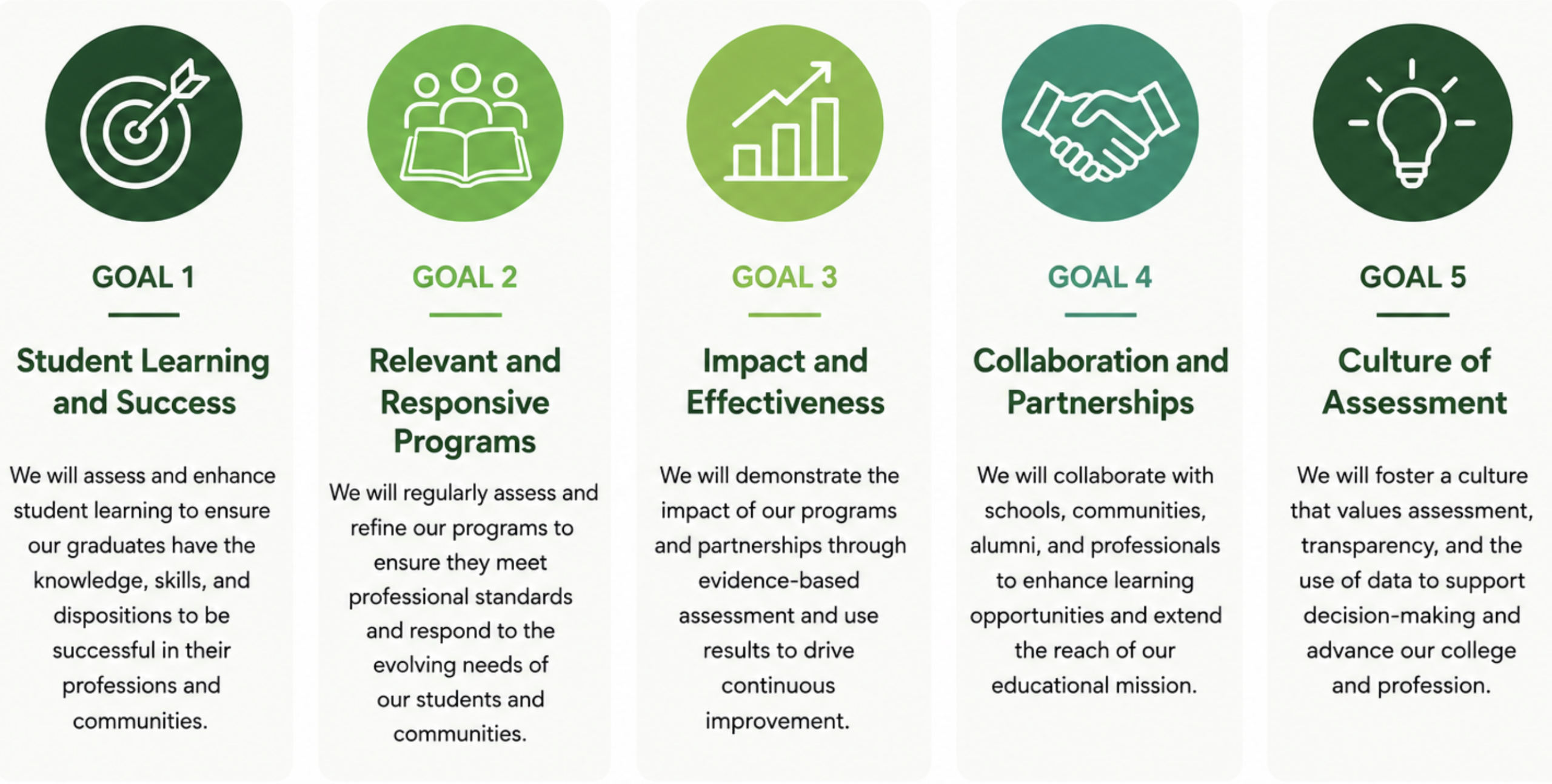
COEPD Office of Assessment Mission & Goals
To advance an integrated, evidence-informed system that unites preparation, practice, and impact to strengthen authentic learning, ethical professional preparation, collaborative improvement, and measurable outcomes across all COEPD degree programs and certificates.
What the COEPD Office of Assessment Supports
The Office of Assessment supports the COEPD by coordinating and advancing evidence-informed practices across all COEPD degree programs and certificates. Key areas of support include:
- Coordination and management of the COEPD Quality Assurance System
- Support for program-level assessment and continuous improvement processes
- Collection, organization, and analysis of candidate performance data
- Development and refinement of performance-based assessments and rubrics
- Alignment of program assessments with professional, state, and national standards
- Support for state and national accreditation processes, including CAEP and specialized accreditations
- Coordination of annual program assessment reporting and documentation
- Facilitation of stakeholder engagement and feedback, including completer and employer input
- Support for the interpretation and use of assessment data to inform program improvement
- Maintenance and reporting of program outcome data, including candidate progression, completion, and effectiveness
Supporting Faculty and Programs
The Office of Assessment works collaboratively with faculty and program coordinators to support meaningful assessment practices that strengthen program quality and student learning. Areas of support include:
- Consultation on the design and revision of performance-based assignments
- Development and refinement of clear, measurable assessment rubrics
- Alignment of course and program assessments with professional and accreditation standards
- Support for integrating key assessments within course structures and learning management systems
- Assistance with interpreting assessment data and identifying areas for program improvement
- Guidance for preparing and submitting annual program assessment reports
- Support for documenting continuous improvement actions and program changes
- Facilitation of collaborative working sessions through the COEPD Assessment Design Studio
- Assistance with organizing and documenting program-level assessment evidence
- Collaboration with faculty to ensure assessment practices reflect authentic learning and professional preparation
Continuous Improvement
Assessment in the COEPD is designed to strengthen teacher education programs and all other COEPD degree programs and certificates. Rather than simply documenting results, assessment data are used by faculty to examine program effectiveness and guide program improvement.
Faculty and program coordinators regularly review multiple sources of evidence, including candidate performance on key assessments, clinical and applied practice evaluations, stakeholder feedback, completer outcomes, and other program-level indicators. These data provide insight into candidate learning, professional preparation, and program outcomes across both teacher education programs and other professional preparation programs within the college.
When patterns or areas for growth are identified, faculty use the findings to inform program-level decisions such as revising assignments, refining assessment rubrics, strengthening course sequencing, enhancing clinical or applied practice experiences, or adjusting program structures to better support candidate success.
Program discussions, decisions, and resulting actions are documented through annual assessment reporting and other program review processes. As new data are collected, faculty examine whether changes have improved candidate performance and program outcomes. Through this ongoing cycle of reviewing evidence, implementing improvements, and evaluating results, COEPD programs remain responsive to professional standards, workforce needs, and the expectations of the communities they serve.