Performance management at Marshall University is a continuous process that supports employee success, strengthens communication between supervisors and employees, and ensures that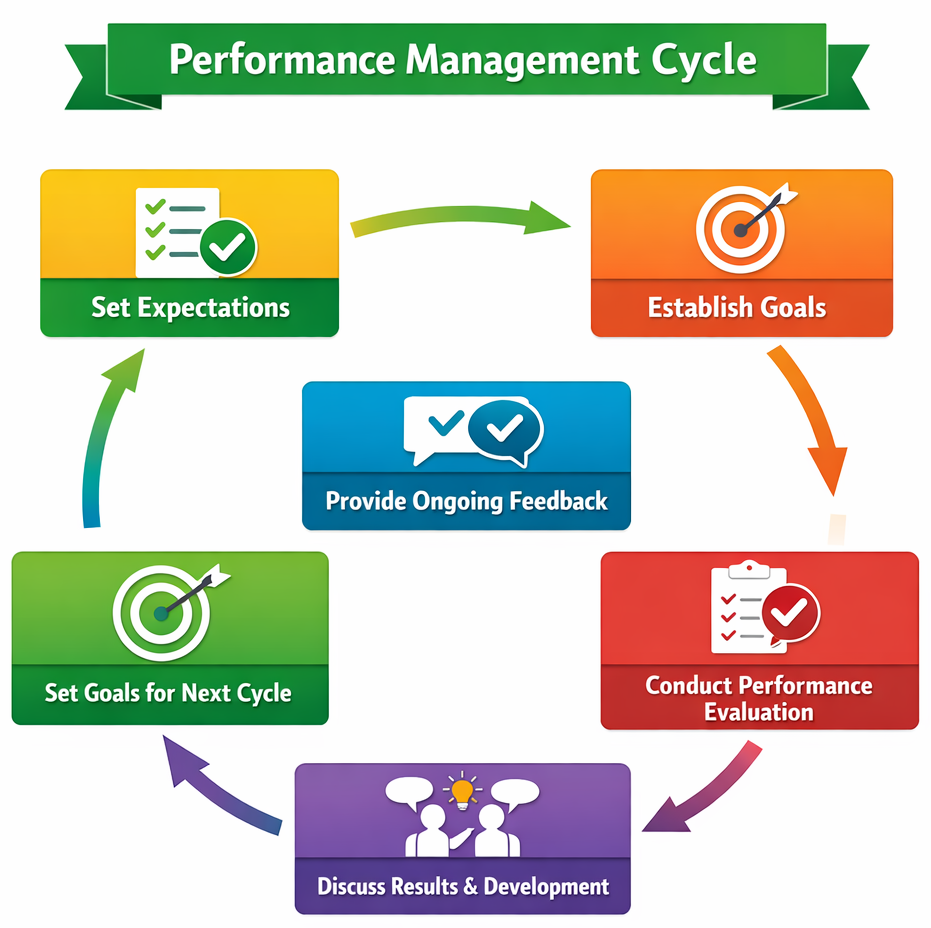 individual contributions align with departmental priorities and the university’s mission. Through ongoing dialogue, goal setting, feedback, and formal evaluations, employees and supervisors work together to support professional growth and institutional success.
The process focuses on:
-
Clear performance expectations
-
Goal setting and professional development
-
Ongoing feedback and communication
-
Formal performance evaluations
Performance Expectations
Supervisors establish clear performance expectations and communicate job responsibilities at the beginning of the evaluation cycle. Expectations should reflect departmental priorities and the employee’s role in supporting the university’s strategic objectives.
Expectations should include:
-
Job responsibilities
-
Performance standards
-
Departmental priorities
-
Institutional goals
Roles and Responsibilities
The performance evaluation process is a shared responsibility between supervisors and employees. The process is designed to promote open communication, clarify expectations, recognize accomplishments, and support continuous professional development. Through ongoing dialogue and collaboration, supervisors and employees work together to ensure that individual performance aligns with departmental priorities and the mission of Marshall University.
Note to Supervisors:The performance evaluation process is intended to be collaborative, constructive, and focused on continuous improvement. When supervisors and employees work together through open communication and shared accountability, the process becomes a valuable tool for recognizing achievements, addressing challenges, and supporting professional growth. Through this collaborative approach, Marshall University seeks to maintain a workplace culture that values performance, accountability, and the ongoing development of its employees.
Supervisors
Supervisors play a critical role in supporting employee success and ensuring the performance evaluation process is conducted in a fair, consistent, and constructive manner. Effective supervisors provide clear expectations, regular feedback, and meaningful guidance that helps employees understand how their work contributes to the success of the department and the university.
Responsibilities:
- Establishing Clear Expectations
Supervisors should clearly communicate job responsibilities, performance standards, and departmental priorities at the beginning of the evaluation cycle. Employees should understand what is expected of them and how their work supports the goals of the department and Marshall University. - Providing Ongoing Feedback
Performance management should be an ongoing process rather than a once-a-year conversation. Supervisors are encouraged to provide regular feedback throughout the year to recognize accomplishments, provide coaching, and address concerns early when they arise. - Documenting Performance
Supervisors should maintain documentation of employee performance during the evaluation period. This may include examples of accomplishments, progress toward established goals, feedback discussions, and any areas where improvement may be needed. Proper documentation helps ensure evaluations are objective and based on observable performance. - Conducting Fair and Accurate Evaluations
Supervisors are responsible for completing evaluations that accurately reflect the employee’s performance during the review period. Ratings should be based on documented performance, achievement of goals, quality of work, reliability, and contributions to departmental and institutional objectives. - Supporting Employee Development
Supervisors should encourage employee growth by identifying opportunities for training, professional development, and skill development that support both individual career advancement and departmental success. - Addressing Performance Concerns
If performance concerns arise, supervisors should address them promptly and constructively. Early communication helps clarify expectations and provides employees with an opportunity to improve performance and meet job requirements.
Employees
Employees play an important role in the performance evaluation process by actively engaging in discussions about their performance and professional development. When employees take an active role in the process, evaluations become more meaningful and supportive of individual growth.
Responsibilites:
-
-
- Understanding Job Expectations
Employees should understand the responsibilities of their position, the performance standards associated with their role, and how their work contributes to the success of their department and the university. - Performing Job Responsibilities Effectively
Employees are expected to perform their assigned duties in a professional and reliable manner while meeting the expectations established for their position. - Participating in Goal Setting
Employees should work collaboratively with their supervisors to establish performance goals that align with departmental priorities and support professional development. - Seeking Feedback and Maintaining Communication
Employees are encouraged to maintain open communication with their supervisors and seek feedback throughout the evaluation cycle to better understand expectations and improve performance. - Preparing for the Evaluation Discussion
Prior to the evaluation meeting, employees should reflect on their accomplishments, progress toward goals, and any challenges encountered during the review period. This preparation helps facilitate a productive evaluation discussion. - Participating in Professional Development
Employees are encouraged to pursue professional development opportunities that enhance their skills, support career growth, and contribute to the overall success of Marshall University.
- Understanding Job Expectations
-
Performance Timelines
Employees that have worked less than 3 months at Marshall. We are still using paper evaluation forms located on the HR Forms site. You will complete their evaluations at the end of the month following following their first work date anniversary in Banner. (ex. If your employee was hired 1/1/2024, their 3-month evaluation would be due May 31st.
Employees that have worked more than 3 month and less than 6 months at Marshall. We are still using paper evaluation forms located on the HR Forms site. You will complete their evaluations at the end of the month following following their first work date anniversary in Banner. (ex. If your employee was hired 1/1/2024, 6 month evaluation would be due August 31st).
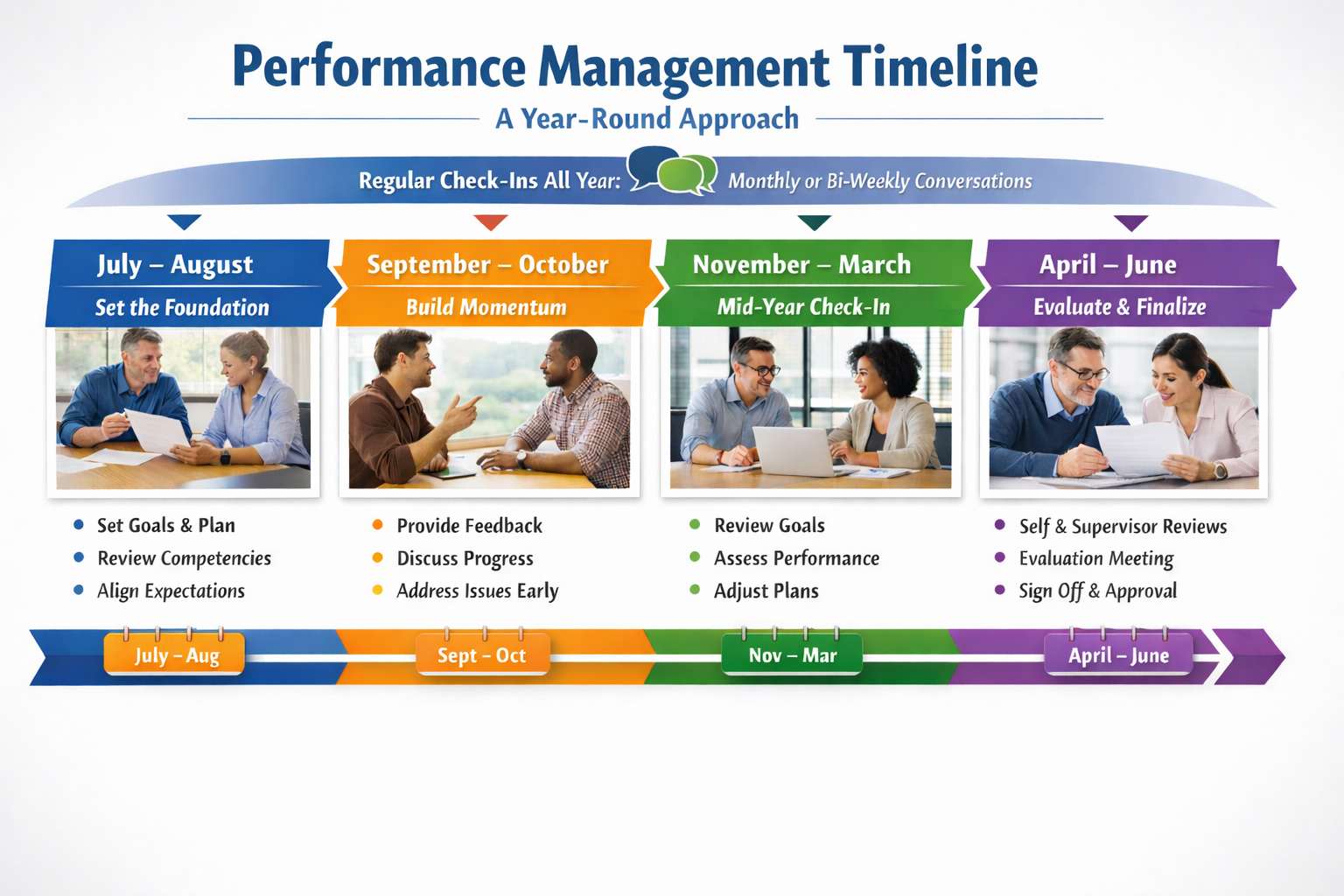
Goal Setting and Professional Development
Supervisors and employees work together to establish goals that support both departmental initiatives and professional development. Goals should not be your day-to-day job duties.
SMART goals (Specific, Measurable, Achievable, Relevant, and Time-Bound) . The most effective evaluation goals usually include:
-
3–5 primary goals
-
At least one professional development goal
-
At least one process improvement or innovation goal
This keeps evaluations focused and measurable.
Response Time Improvement
Respond to internal and external inquiries within 24 hours during normal business operations throughout the evaluation cycle.
Document Management
Ensure that 100% of departmental records and files are accurately organized and stored according to university record-keeping standards by the end of the evaluation period.
Event Coordination
Successfully coordinate at least three departmental meetings or events during the evaluation cycle while maintaining positive participant feedback.
Process Improvement
Identify and implement at least one improvement to an administrative process that increases efficiency or reduces turnaround time.
Professional Development
Complete at least two professional development opportunities related to administrative support, university systems, or communication skills.
Student Advising Engagement
Meet with at least 85% of assigned students for advising appointments during each academic semester.
Advising Documentation
Document 100% of advising sessions in the student information system within 48 hours of the meeting.
Student Retention Support
Contact students flagged through early alert systems within two weeks and provide appropriate resources or follow-up support.
Workshop Participation
Organize or participate in at least two student success workshops or outreach initiatives during the academic year.
Professional Development
Complete at least two professional development trainings related to advising strategies, student success, or university policy updates.
Help Desk Response
Respond to 90% of help desk tickets within one business day and resolve standard issues within three business days.
System Reliability
Maintain system uptime of at least 99% for critical university systems during the evaluation cycle.
Cybersecurity Awareness
Assist with implementing at least one cybersecurity awareness initiative or training session for university employees.
Technology Improvement
Research and recommend at least one technology improvement that enhances operational efficiency or security.
Documentation
Maintain updated documentation for IT systems and procedures to ensure knowledge sharing and continuity.
Work Order Completion
Complete 90% of assigned maintenance work orders within five business days of assignment during the evaluation period.
Preventative Maintenance
Perform scheduled preventative maintenance tasks on equipment and facilities according to departmental timelines.
Safety Compliance
Maintain full compliance with campus safety procedures and participate in all required safety training programs.
Campus Appearance
Maintain assigned campus areas to ensure they meet departmental cleanliness and safety standards.
Operational Efficiency
Identify and implement at least one efficiency improvement related to equipment use, materials, or work processes.
Understanding Annual Performance Evaluation Score Ranges
Annual Performance evaluations are assigned scores in the PeopleAdmin system. These scores are intended to provide an objective assessment of how well an employee performs the responsibilities of their position and meets established performance goals. These scores help supervisors evaluate the quality, consistency, and impact of an employee’s work over the course of the evaluation period. Each score range represents a different level of performance relative to the expectations of the role, allowing supervisors to distinguish between performance that meets expectations, exceeds expectations, or requires improvement.
Evaluation ratings should be based on documented performance, measurable outcomes, and the employee’s ability to successfully carry out the essential duties of their position. Factors such as completion of assigned responsibilities, achievement of annual goals, quality of work, reliability, collaboration, and contributions to departmental or institutional objectives should all be considered when determining an appropriate rating.
It is important that evaluation scores accurately reflect an employee’s actual performance. Ratings should not be assigned for the purpose of increasing compensation or providing a higher pay outcome. Inflated ratings can undermine the integrity of the evaluation process and create inconsistencies across departments. Performance evaluations are intended to provide meaningful feedback, recognize strong performance, identify opportunities for improvement, and support employee development.
When compensation adjustments are available, evaluation scores may be one factor considered in compensation decisions; however, salary increases are subject to institutional policies, budget availability, and other considerations such as internal equity and market factors. Maintaining consistent and accurate evaluation ratings helps ensure that the performance management process remains fair, transparent, and aligned with the university’s standards of accountability and excellence.
Value (4) – Exceptional
Score Range: 3.50 – 4.00
Exceptional performance represents work that significantly exceeds expectations and produces extraordinary results. Employees receiving this rating consistently perform at the highest level and make contributions that have a meaningful and lasting impact on their department, division, or the university.
Employees in this category typically:
-
Deliver consistently outstanding results beyond their job requirements
-
Demonstrate exceptional initiative and leadership
-
Solve complex problems or implement innovative solutions
-
Significantly improve processes, programs, or outcomes
-
Serve as role models for others across the department or institution
This rating is reserved for truly exceptional performance and should be used sparingly for employees whose contributions have a transformational or “game-changing” impact.
Value (3) – Exceeds Expectations
Score Range: 3.00 – 3.49
Employees rated as Exceeds Expectations consistently perform above the normal requirements of their role. Their work quality is excellent, and they regularly go beyond standard expectations in completing responsibilities and achieving goals.
Employees in this category typically:
-
Consistently perform at a high level across all major responsibilities
-
Meet and often surpass annual goals
-
Demonstrate strong initiative and reliability
-
Produce high-quality work with minimal supervision
-
Contribute positively to team performance and departmental success
This rating indicates sustained high performance, but the impact may not rise to the level of transformational or institution-wide change.
Value (2) – Meets Expectations
Score Range: 1.76 – 2.99
Meets Expectations represents solid and dependable performance. Employees in this category consistently fulfill the requirements of their role and perform their duties effectively.
Employees in this category typically:
-
Complete assigned responsibilities successfully
-
Maintain consistent and reliable work performance
-
Meet the most critical annual goals
-
Demonstrate competency in their position
-
Occasionally exceed expectations in certain areas
This rating reflects fully successful job performance and is the most common rating for employees who are meeting the expectations of their position.
Value (1) – Needs Improvement
Score Range: 0.00 – 1.75
Needs Improvement indicates that performance does not consistently meet expectations in one or more key areas of responsibility. Employees receiving this rating may require additional guidance, development, or corrective action to meet job expectations.
Employees in this category may:
-
Fail to meet one or more essential job responsibilities
-
Not achieve critical performance goals
-
Require frequent supervision or corrective feedback
-
Demonstrate inconsistent work quality or reliability
-
Need additional training, support, or performance improvement planning
Supervisors should work with employees to identify performance gaps and develop a clear plan for improvement, which may include coaching, additional training, or a Performance Improvement Plan (PIP).
Ongoing Feedback
Effective performance management extends beyond the annual evaluation. Supervisors are encouraged to provide ongoing feedback throughout the year, recognizing strong performance and addressing concerns when they arise. Regular communication allows employees to better understand expectations, make adjustments when necessary, and continue developing professionally.
Open and constructive dialogue between supervisors and employees helps foster a respectful, collaborative workplace and supports continuous improvement across the university. Regular communication helps employees stay aligned with departmental priorities and maintain strong performance.
Performance Coaching
When performance concerns arise, supervisors should:
- Address concerns as soon as they are identified.
- Clearly communicate performance expectations.
- Provide specific examples of performance gaps or behaviors that need improvement.
- Offer coaching, guidance, and appropriate resources to support success.
- Collaborate with the employee to establish measurable improvement goals and action steps.
- Document conversations, expectations, and agreed-upon timelines.
- Schedule follow-up meetings to review progress and provide additional feedback.
- Consult with Human Resource Services when guidance or additional support is needed.
When appropriate, supervisors may implement a Performance Improvement Plan (PIP) to formally outline performance expectations, establish measurable objectives, define timelines for improvement, and provide employees with the support necessary to achieve successful performance.
Difficult conversations are a normal part of effective supervision. Addressing concerns respectfully and professionally helps build trust while ensuring accountability. Supervisors should focus on resolving issues rather than assigning blame.
When conducting a performance discussion:
- Address concerns privately and promptly.
- Focus on observable behaviors and performance rather than personal characteristics.
- Practice active listening to better understand the employee’s perspective.
- Determine whether the issue is related to skill (the employee lacks knowledge or ability) or will (the employee is capable but unwilling or inconsistent in meeting expectations).
- Consider whether external circumstances may be contributing to the performance issue.
- Clearly communicate expectations for improvement.
- Establish measurable goals and follow-up timelines.
- Reinforce accountability while demonstrating support for employee success.
Even experienced supervisors can encounter challenges when managing employee performance. Avoiding these common pitfalls can improve the effectiveness and fairness of the evaluation process.
- Delaying or avoiding difficult conversations.
- Setting inconsistent or unclear expectations.
- Failing to provide regular coaching and ongoing feedback.
- Relying only on recent events rather than evaluating performance throughout the review period (recency bias).
- Maintaining inadequate documentation.
- Inflating or deflating ratings to avoid uncomfortable conversations.
- Allowing personal bias or favoritism to influence evaluations.
- Focusing only on deficiencies instead of employee development.
- Failing to follow through on commitments, improvement plans, or scheduled follow-up discussions.
Effective performance management is an ongoing process—not a once-a-year event. Supervisors who consistently communicate expectations and provide meaningful feedback create stronger employee engagement and improved performance.
Successful supervisors:
- Set clear expectations from the beginning.
- Provide frequent coaching and recognition throughout the year.
- Deliver timely, honest, and constructive feedback.
- Document performance consistently and objectively.
- Address concerns early before they escalate.
- Recognize employee strengths while identifying development opportunities.
- Collaborate with employees to establish meaningful goals.
- Follow through on commitments and hold employees accountable.
- Partner with Human Resource Services when additional guidance is needed.
This proactive approach helps create a culture of accountability, continuous improvement, and professional growth while supporting the mission and values of Marshall University.
Training for Supervisors
For training and guidance on Employee Relationships and Performance Evaluations available by registering on our Training and Development page below.
Visit the HR Training Schedule