A. Grade Point Average (GPA) Marshall University Forensic Science Program Average Incoming Undergraduate GPA versus Exit MSFS GPA
Graph A: This graph provides the average undergraduate GPA for students coming into the Forensic Science Program as well as the average GPA upon graduation from the Program.
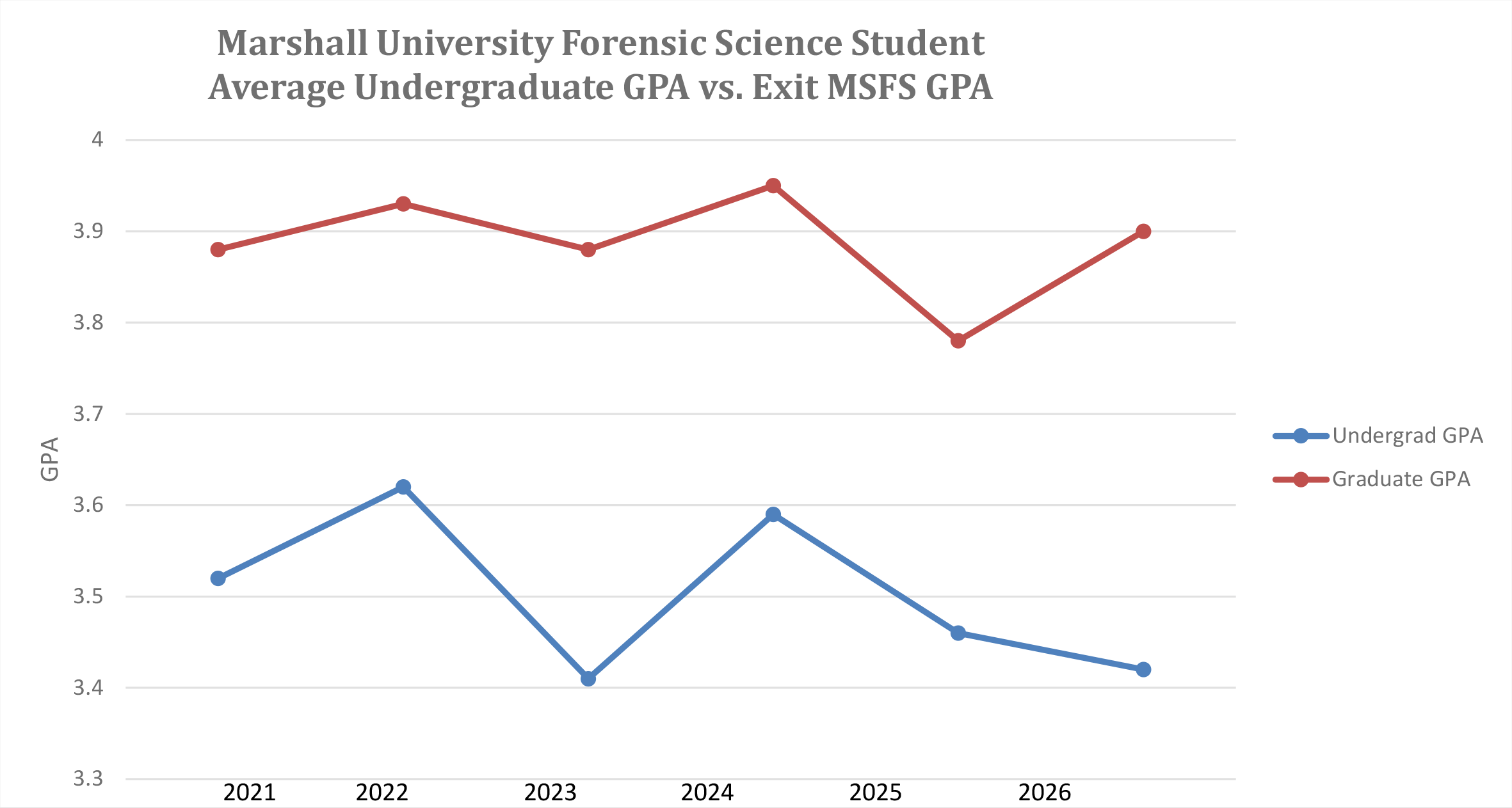
Graph A: Marshall University Forensic Science Student Average Undergraduate GPA vs. Exit MSFS GPA
B. Employment Statistics: Marshall University Graduate Employment Statistics
Table B: Breakdown of employment by category for graduates of each class of the Forensics Science Program as well as the totals for all graduates from the past 10 years.
10-Year Employment Statistics
| Class | Total Students | Forensic Science | Forensic Science Related | Non-Forensic Science Related | Advanced Degrees | Did Not Respond |
|---|---|---|---|---|---|---|
| 2015 | 19 | 18 (94.70%) | 0 (0.00%) | 0 (0.00%) | 1 (5.30%) | 0 (0.00%) |
| 2016 | 15 | 10 (66.70%) | 2 (13.33%) | 0 (0.00%) | 2 (13.33%) | 1 (6.67%) |
| 2017 | 17 | 13 (76.00%) | 0 (0.00%) | 0 (0.00%) | 1 (5.88%) | 3 (17.65%) |
| 2018 | 15 | 9 (60.00%) | 0 (0.00%) | 0 (0.00%) | 1 (6.60%) | 3 (20.00%) |
| 2019 | 18 | 14 (77.77%) | 3 (16.66%) | 1 (5.55%) | 0 (0.00%) | 0 (0.00%) |
| 2020 | 12 | 6 (50.00%) | 1 (8.33%) | 1 (8.33%) | 1 (8.33%) | 2 (16.67%) |
| 2021 | 17 | 12 (70.50%) | 2 (13.33%) | 0 (0.00%) | 0 (0.00%) | 3 (17.65%) |
| 2022 | 11 | 7 (63.63%) | 0 (0.00%) | 0 (0.00%) | 0 (0.00%) | 2 (18.18%) |
| 2023 | 7 | 6 (85.71%) | 1 (14.29%) | 0 (0.00%) | 0 (0.00%) | 0 (0.00%) |
| 2024 | 12 | 11 (91.67%) | 0 (0.00%) | 0 (0.00%) | 0 (0.00%) | 0 (0.00%) |
| 2025 | 6 | 3 (66.67%) | 2 (33.33%) | 0 (0.00%) | 1 (0.00%) | 0 (0.00%) |
| Total | 149 | 110 (73.83%) | 11 (7.38%) | 2 (1.34%) | 7 (4.70%) | 14 (9.40%) |
* Individuals classified as having a Forensic Science job are those in the actual field of Forensic Science after graduation with respect to the relevancy of their degree obtained. Examples of this would be as follows: Laboratory or field work with forensic governmental agencies, private corporations, etc.
Table B: Employment Statistics 2026 (PDF)
C. Professional Development Marshall University Forensic Science Graduate Student Presentation at the American Academy of Forensic Sciences Annual Meeting or MAAFS Regional Meeting
Graph C: This graph provides the number of second-year students attending compared to the total number of students enrolled in the program for that year. “Percent Presenting” is based on the number of students who were selected to present a poster or podium presentation at the meeting compared to the total number of second-year students in the Program.
Second-year students have completed research projects to be eligible for national meeting presentation.
Important Note: 2021 shows 0 attendance due to Covid. Attendance from 2022 and 2023 include virtual attendance.
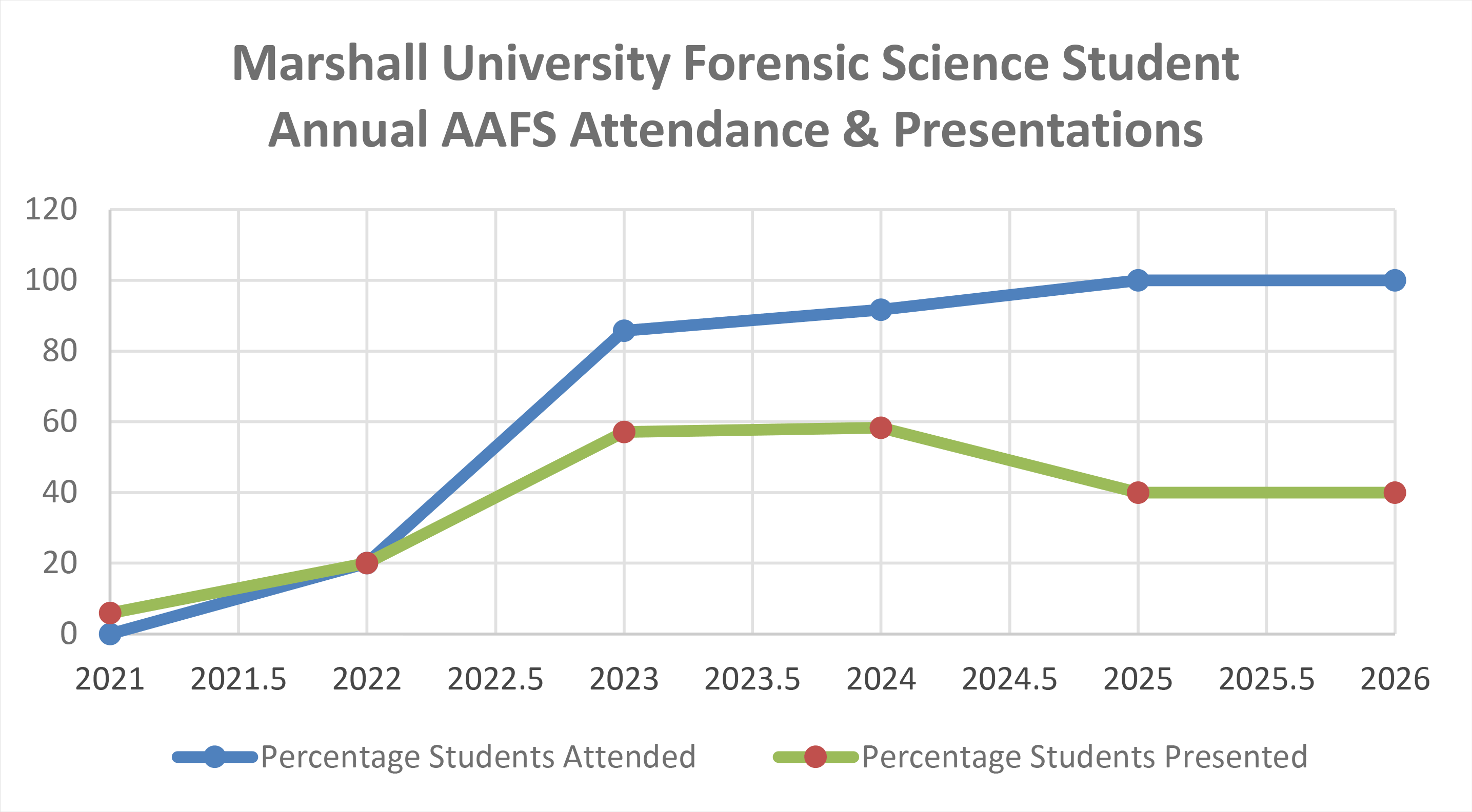
Graph C: Students at AAFS National or other Regional Meetings: Percentage (%) of Presenters and Attendees per Class per Year
D. Incoming Student GRE Score Averages
Graph D1 & D2: These graphs provide average GRE scores of applicants accepted into the MUFS graduate program for the past 5 years in the areas of verbal, quantitative, and writing.
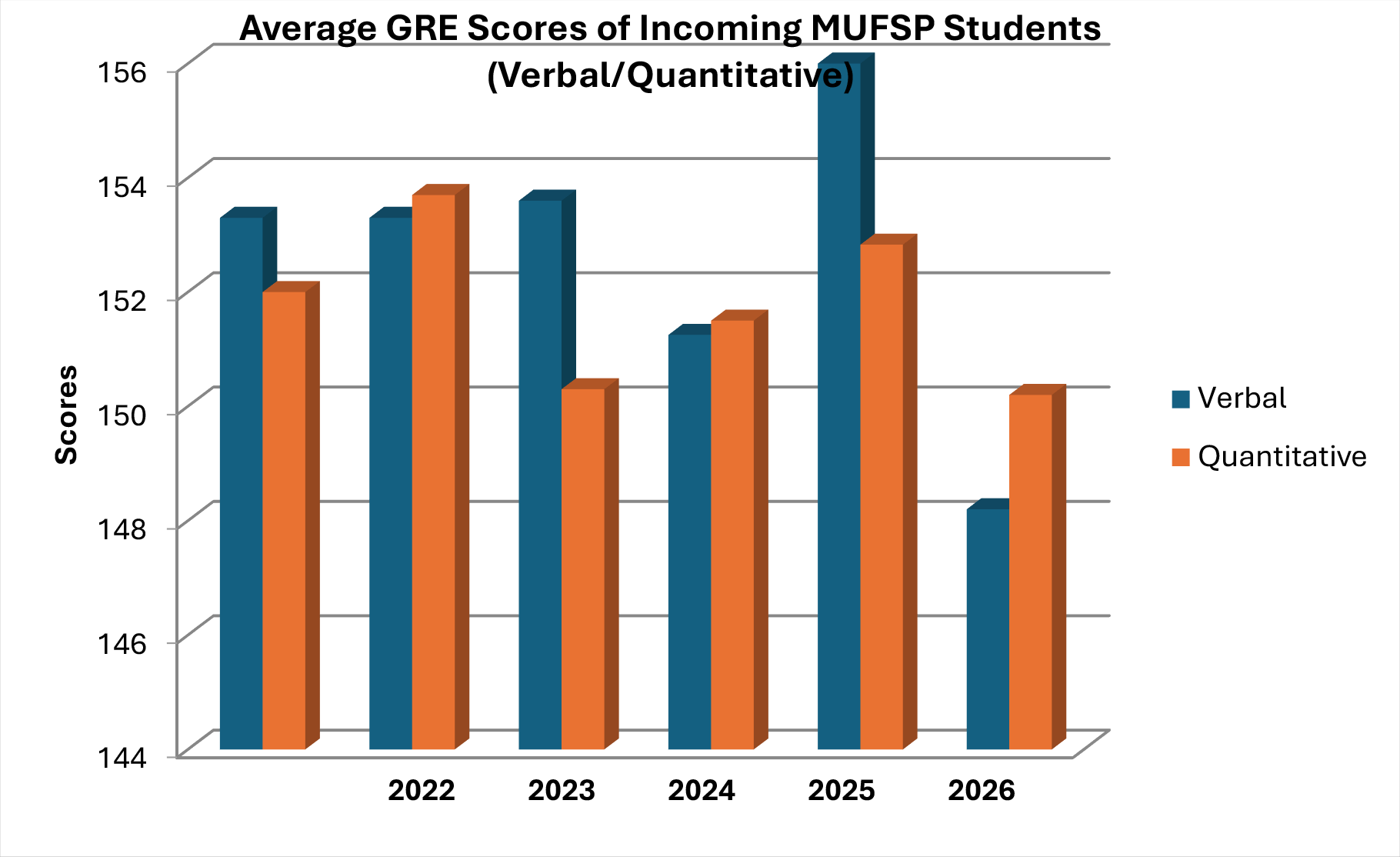
Graph D1: Average GRE Scores of Incoming MUFSP Students (verbal/Quantitative)
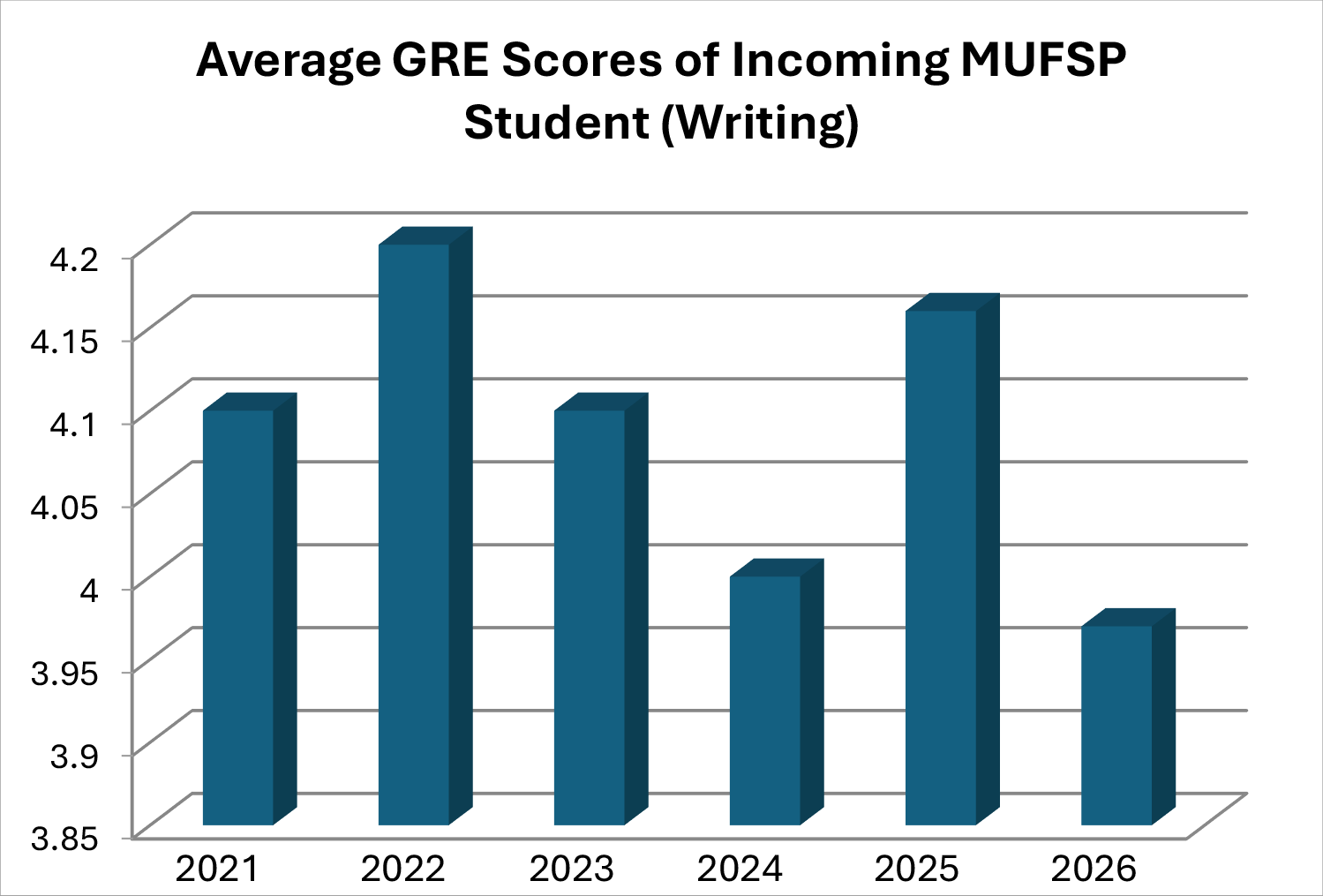
Graph D2: Average GRE Scores of Incoming MUFSP Students (Writing)
E. Enrollment & Graduates Data
Table E; Student enrollment for the past three academic years: total enrollment, number enrolled in each emphasis, and number graduated.
|
Masters of Science in Forensic Science |
Academic Year: Past 3rd Year 2023- 2024 |
Academic Year: Past 2nd Year 2024 – 2025 |
Academic Year: Previous Year 2025 – 2026 |
|---|---|---|---|
| # of full time students enrolled in degree program | 19 | 11 | 12 |
| # of students enrolled in each concentration /emphasis/ track (if applicable) |
DNA: 16 Chemistry: 13 Crime Scene: 18 Digital: 9 |
DNA: 10 Chemistry: 9 Crime Scene: 9 Digital: 4 |
DNA: 7 Chemistry: 9 Crime Scene: 8 Digital: 4 |
| # of graduates in reported in each year | 12 | 12 | 5 |
Table E: Enrollment & Graduates Data 2026 (PDF)
F. Internship, Research Project, & Capstone Experience Information
Table F: Summary of research experiences, project titles, and host agencies.
Most Recently Completed Academic Year 2025-2026
| Type of Experience | Title or Topic of research project / area of study: | Location (applicable if internship is the ‘type of experience’): |
|---|---|---|
| Internship | Forensic Implications of Non-Touch Environmental DNA for Low-Template DNA Interpretation | Marshall University Forensic Science Department, Huntington, WV |
| Internship | Evaluation of Laminated Veneer Lumber (LVL) and Commercial Polyurethane Spray Foam Insulation as Potential Interfering Substrates in Fire Debris Analysis | Huntington Fire Department/Fire Marshal, Huntington, WV |
| Internship | Internal Instrument and Software Validation for Analysis of DNA Databank Samples | Kansas Bureau of Investigation, Topeka, KS |
| Internship | Evaluating the Performance of Fluorescent Fingerprint Powders | Marshall University Chemistry Department, Huntington, WV |
| Internship | GC-IRD-MS Method Development and Evaluation of Computationally Predicted Infrared Spectra for Psychoactive Drugs | Customs & Boarder Protection INTERDICT Science Center, Ashburn, VA |
| Internship | Internal Validation of the RapidHIT ID System v2.1 and RapidLINK Software | West Virginia State Police Forensic Laboratory, Charleston, WV |
| Internship | Investigating Gender Differences in Fingerprint Ridge Density | Huntington Police Department, Huntington, WV |
Previous Academic Year 2024-2025
| Type of Experience | Title or Topic of research project / area of study: | Location (applicable if internship is the ‘type of experience’): |
|---|---|---|
| Internship | Analysis of IL by GC-MS with H2 Carrier Gas | Pinellas County Forensic Laboratory |
| Internship | SpermX extraction with a GenSpin Tube | Palm Beach County Sherriff’s Office |
| Internship | Evaluation of Vapor Pressures of Ignitable Liquids Water and Fire Debris Analysis, and the Effects on Extraction | ATF Forensic Science Laboratories (FSL) in Ammendale, Maryland |
| Internship | MSTFA Derivatization of cannabinoids for GC/MS analysis | Kentucky State Police, Eastern Laboratory, Ashland, KY |
| Internship | UV/Vis analysis of dried plant material extracts for the semi-quantitative detection of THC | Marshall University Forensic Science Department, Huntington, WV |
Previous Academic Year 2023-2024
| Type of Experience | Title or Topic of research project / area of study: | Location (applicable if internship is the ‘type of experience’): |
|---|---|---|
| Internship | Investigation of the Impact of the Fire Debris Sample Extraction Process on Latent Prints | Marshall University Forensic Science Department, Huntington, WV |
| Internship | Impact of Sound Suppressors on Gunshot Residue Deposition. | Harris County Institute of Forensic Sciences in Houston, Texas |
| Internship | Determining Discriminatory Power for Tool Paint (FTIR, MSP, SEM-EDS) and Hot Melt Adhesives (XRF, SEM-EDS, FTIR) | ATF Forensic Science Laboratories (FSL) in Ammendale, MD |
| Internship | Validation of Tetrahydrocannabinol Acid Derivatization | West Virginia State Police Forensic Laboratory, Charleston, WV |
| Internship | Persistence and Recovery of Touch DNA on Door Handles Over Time | Marshall University Forensic Science Department, Huntington, WV |
| Internship | Implementation of the Intermountain Bone and Tooth Extraction and Purification Protocol to Improve DNA Extraction from Bone | Palm Beach County Sheriff’s Office, West Palm Beach, FL |
Table F: Internship, Research Project, & Capstone Experience Data 2026 (PDF)