
Humanistic Online Model for Engagement
The H.O.M.E. Framework is Marshall University’s required certification for faculty teaching online. All online instructors must complete this qualification by June 30, 2026.
Mission Statement
To support faculty in the development and delivery of learning experiences that promote research-based best practices – all in the service of students.
Regular and Substantive Interaction (RSI) Criteria in Design and Delivery
While the criteria to meet Quality Matters (QM) standards is confined to online course design, the criteria to meet RSI involves both design and delivery.
It’s important to appreciate the legal and financial implications surrounding the definitions of online interaction set forth by the Department of Education when Title IV funds are used for online instruction (NC-SARA, 2021). See Regular and Substantive Interaction: Background, Concerns, and Guiding Principles (provided by OTL, UPCEA, and WCET) and a brief on recent updates.
For this reason, we must take a proactive approach to Marshall’s standards for online learning.
Strategic Priorities
In-Demand Curriculum, On-Demand Delivery, Transformative Student Success, and End-to-End Student Experience all depend upon top-notch course design and delivery. By embracing these priorities and incorporating innovative approaches, faculty can create a transformative online learning experience that prepares students for the challenges of the modern world. To see how online learning plays a central role in the Master Plan, take a look at the Plan-On-a-Page.
Belonging at Marshall
The most important driver in adopting a humanistic approach is simple: students who feel connected and confident persist. Belonging = Retention.
- Learn more about how Online Learning is promoting Belonging at Marshall.
- Learn more about how to cultivate a Culture of Care in online environments.
Online Learning is dedicated to providing resources that advance effective online teaching and course design. This Course Checklist serves as an evaluative tool in the Course Review process to gauge how well a course aligns with established, research-based standards. Additionally, the Regular and Substantive Interaction (RSI) guidelines offer crucial insights into student-instructor engagement, along with strategies to aid faculty in meeting RSI requirements set forth by the Department of Education.
Because it is focused on delivery as well as design, the Framework goes beyond the familiar Structural Standards to also include Experience Standards. This is the result of a collaborative effort among instructional designers and faculty to (1) vet industry-standard components for quality assurance and (2) customize Marshall-specific standards for a humanistic experience.
The H.O.M.E. Framework presents 6 standards, each accompanied by annotations. The Essential Standards of the H.O.M.E. Framework are:
- Transparent Course Design
- Outcomes & Assessment
- Learner Engagement
- Learning Awareness
- Active Learning
- Belonging
During the Course Development or Review process, faculty will collaborate with the Instructional Design Team. The Collaborative Checklist provides a means of communication back and forth throughout the process. It is intended to be malleable, allowing faculty to add notes, questions, concerns.
Training Opportunities
Please see Design Center Events for information pertaining to Face-to-face and Asynchronous H.O.M.E. Framework trainings.
Part 1: Essential Structure Standards
Standard 1: Transparent Course Design: Clarifying Expectations
Based on the Transparency in Learning and Teaching (TILT) framework.
Overview: The course introduction establishes the course environment, acquaints students with expectations, outlines essential details regarding technology requirements and course policies, establishes communication and engagement standards, introduces the learning outcomes/competencies, and offers guidance for student success.
-
- 1A: Includes a “Start Here” module containing:
- accessible syllabus
- instructor contact information
- course introduction video
- learner introductions
- 1B: Organizes and optimizes course design for student success through chronological order, using:
- modules/units/folders
- 1C: Specifies expectations for required synchronous and asynchronous sessions and their purposes, including:
- course schedule – accurate to the semester with meeting dates reflecting when/where/how
- accessible syllabus
- course structure
- policies
- technology requirements
- feedback timeframes are clearly communicated
- 1D: Instructional Materials:
- follow permissions
- make access instructions clear to students from start date
- are clearly relevant to course
- 1A: Includes a “Start Here” module containing:
- Include all elements of a standard Start Here folder, including multimedia elements such as:
- Consider the use of multiple Blackboard tools to create instructor presence. Explore our Best Practices and News Archives Resources.
- Provide links to all Marshall policies and course delivery modalities.
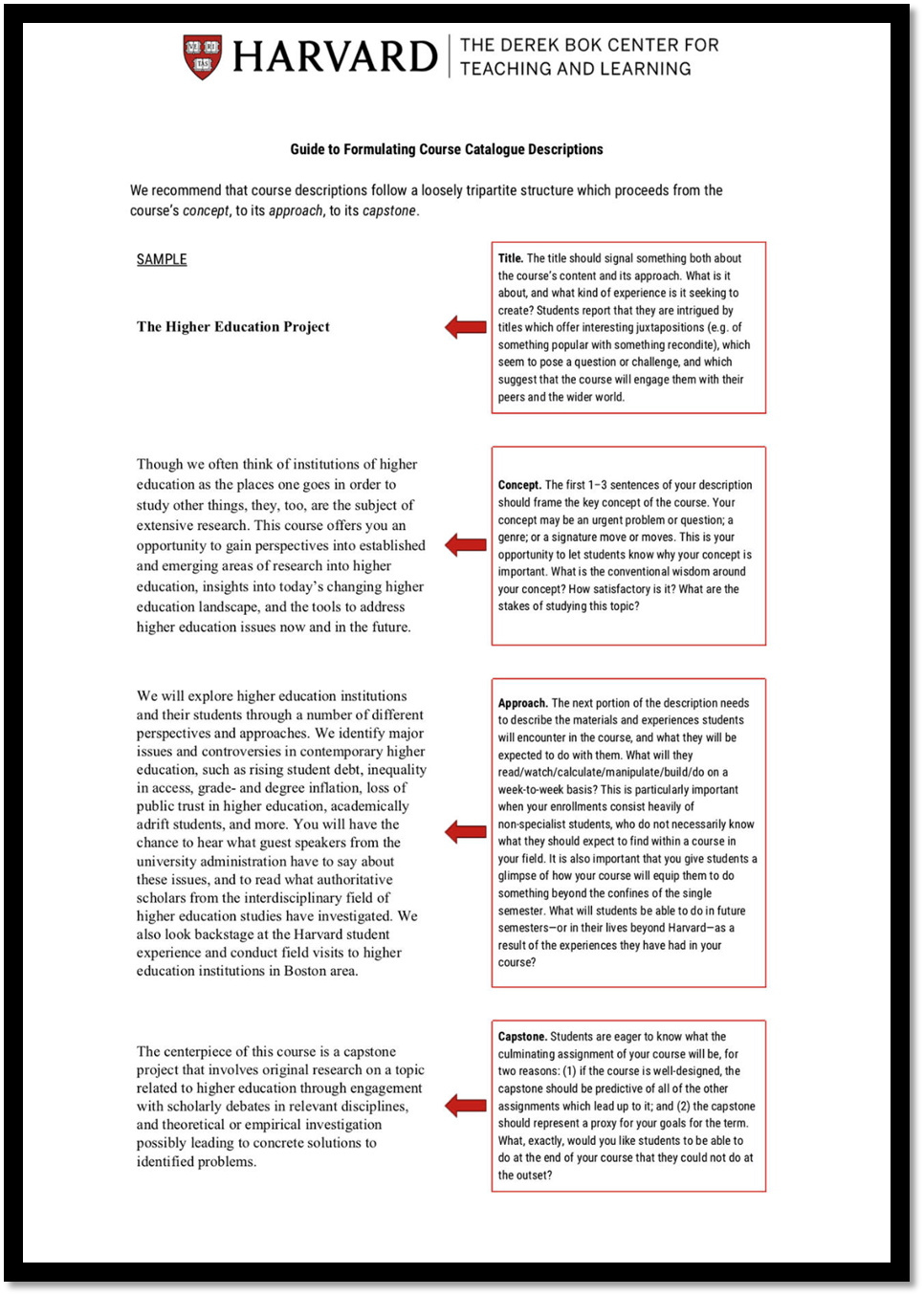
- Provide a Course Description with essential components: (1) major course questions, (2) daily course experience, (3) capstone expectations.
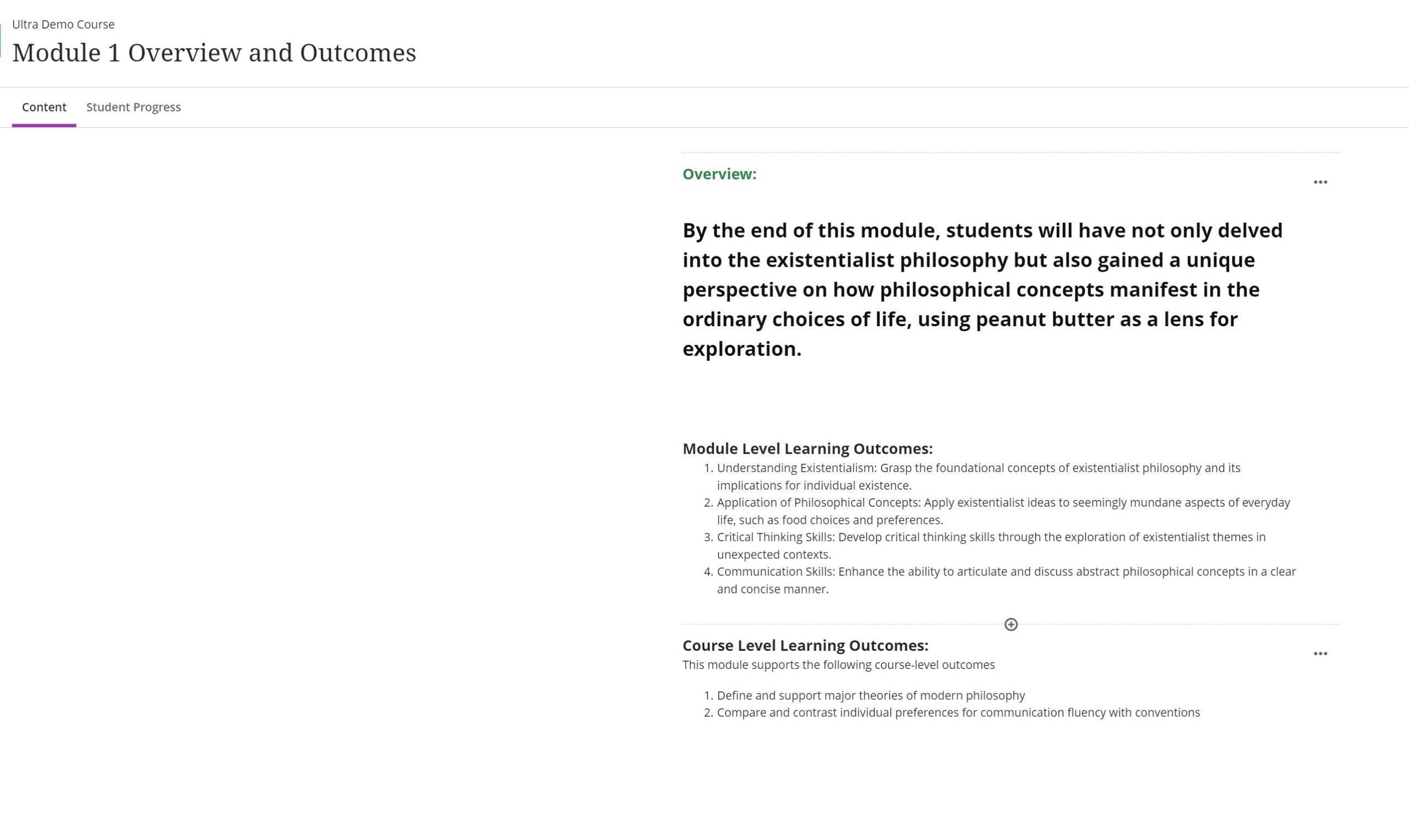
- Include an Overview for each module to provide context
- Include a Course Navigation video.
- Include a Course Map to chart how activities relate to outcomes.
- Use an Annotated Syllabus to ensure student engagement with introductory content.
- Use TILT Higher Ed (Transparency In Learning and Teaching) template: purpose, task, criteria.
- Use Backward Course Design.
- Provide Course Design rationale to students (general and specific) whenever possible.
Standard 2: Outcomes & Assessment: Clarifying Alignment and Relevance
Based on AAC&U best practices according to the V.A.L.U.E. alignment.
Overview: Assessment and measurement are designed and delivered in accordance with the course’s learning outcomes/competencies. This not only enables the instructor to evaluate learners’ mastery of content but also empowers learners to monitor their progress throughout the course.
-
- 2A: Clearly indicates how course-level learner outcomes are:
- measurable – through the use of measurable verbs.
- segmented into distinct learning units or modules -with clear unit-level outcome statements.
- aligned to unit-level course content, tools, and learning activities – with clear connective statements.
- aligned to instructional materials – with clear statement of relevance.
- 2B: Example assessments and rubrics are supplied prior to due dates.
- 2C: Multiple opportunities are provided for learners to practice and receive feedback (Formative Assessments) prior to summative assessments.
- 2A: Clearly indicates how course-level learner outcomes are:
- Course and unit Outcomes are present in syllabus.
- Each Module-level Unit contains learning outcomes that are achievable within the scope of the module.
- Every learning outcome contains a measurable verb based on Bloom’s Taxonomy.
- Clearly identify the required Course Outcomes that are specific to Marshall’s Baccalaureate Degree Profile (BDP) Competencies (based on AAC&U Value Rubrics) by:
- Consulting Marshall’s Assessment Page
- Consulting BDP Competencies and General Education Requirements.
- Clearly label BDP outcomes on each Assessment.
- Explicitly label Authentic Assessments – Provide explanations for how course outcomes relate to real-world skills.
- Provide explanations for how course outcomes are scaffolded within the context of (1) the discipline and/or (2) the BDP’s progression.
- Include an opportunity for students to provide course-review feedback prior to the end of the semester. Consider using these Engagement Course-review Surveys addressing Belonging, Durable Skills, and HOME Standards to gain insight into the student experience. These questions can offer valuable information regarding retention and persistence.
Part 2: Essential Experience Standards
Standard 3: Learner Engagement: Establishing Regular and Substantive Interaction
Based on the regulatory definitions outlined by the Higher Education Opportunity Act.
Overview: Transformative learning experiences – especially online – occur when learners can engage with the instructor and fellow learners, fostering a community of inquiry. Collaborative-constructivist interactions among learners may develop in traditional classroom settings without intentional design. In online environments, it’s essential to foster both learner-learner and learner-instructor engagement.
-
- 3A: Establishes communication norms for a welcoming environment.
- 3B: Encourages learner-instructor engagement through various means.
- 3C: Promotes learner-learner engagement through various means.
- Communicate expected response times for email and online communication between instructor-student
- Provide models for learner-learner engagement
- Provide personalized feedback
- Provide weekly course announcements
- Provide weekly summaries or highlights of discussion posts
- Offer regularly scheduled help sessions and consistent weekly office hours
- Welcome module contains a welcoming message with Introduction Video
- Actively moderate and participate in discussions to guide conversations, provide expert input, and keep discussions on track. (Research shows that students are more likely to value discussions with active moderation)
- Include formative assessments that focus on Social and Emotional Learning
- Provide explanations to students on the role of social learning in online environments.
Standard 4: Learning Awareness: Cultivating Motivation and Reflection
Based on UDL guidelines, epistemological growth models, AAC&U’s VALUE rubrics on Critical and Metacognitive Thinking, and Bloom’s affective taxonomy.
Overview: The Constructivist approach acknowledges the role that intrinsic motivation plays in producing deep and lasting learning. Therefore, course design promotes relevance, offers a degree of agency, and provides opportunities to connect personally with the content.
-
- 4A: Encourages learners to reflect on how skills and knowledge transfer into career and personal goals.
- 4B: Provides opportunities for learners to develop contextual thinking
- 4C: Promotes self-awareness and growth mindset.
- Design assessments that help students to progress from Absolute Thinking toward Contextual Thinking. Refer to AAC&U VALUE rubrics on Critical Thinking and Metacognitive Thinking when designing assessments that measure reflective and contextual thinking. These rubrics are already in use for General Education assessments and can easily be aligned to your assignments using Blackboard’s Goals & Standards tool.
- When designing for contextual thinking, select tasks that ask learners to grapple with the complexities of a discipline, allowing them to practice thinking and acting as professionals do.
- Offer students a variety of assessment methods that allow them to pursue individualized choices. This promotes lifelong learning by using intrinsic motivation. Motivate with the 6 C’s:
- Choice
- Constructing Meaning
- Control
- Challenge
- Consequence
- Collaboration
- Engage learners with activities that are relevant to their experience and/or goals. Attention is most focused where meaning and context converge.
- Connect with the Design Center to create Belonging/Growth Mindset opportunities for your students using the “Saying is Believing” approach.
- Explicitly label goals and outcomes that align to NACE competencies.
- Design metacognitive opportunities for students to develop awareness of their own epistemological growth.
- Make andragogy explicit: expose students to Bloom’s taxonomy, Maslow’s hierarchy, theories of learning and Growth Mindset.
- Include one or more summative assessment(s) designed to function as an authentic assessment.
Standard 5: Active Learning: Facilitating Discovery
Based on UDL guidelines as outlined by CAST.
Overview: This standard places a significant emphasis on cultivating an environment where students are not merely recipients of information but active participants in their learning journey. It addresses how well the course design encourages students to explore, experiment, and assess concepts.
-
- 5A: Includes opportunities that support discovery, evaluation, or original creation
- Design self-guided research projects that allow learners agency to practice behaviors associated with the kind of professional curiosity that operates within the discipline
- Design assessments that showcase real-world problem-solving with an emphasis on application
- Include Discussion Board rubrics that demonstrate the academic value of meaningful engagement in discourse.
- Incorporate authentic assessments such as:
- hands-on professional simulations
- peer-reviewed assignments
- Mentorship programs
- industry-specific capstone projects
- Provide opportunities for learners to actively participate in formative interactions:
- community forums
- interactive lectures and knowledge checks
- adaptive learning modules
- virtual labs
- Design assessments that include student-led discussions
- Design assessments that invite students to explore the Threshold Concepts associated with your discipline.
- Use rubrics that clearly indicate the rigor that is expected on a college level discussion board, such as analysis based rubrics, self-evaluation rubrics, or one that specifically targets the “post and respond” format.
Standard 6: Belonging: Prioritizing Community and Access
Based on UDL guidelines.
Overview: The course design incorporates Universal Design for Learning (UDL) principles, demonstrating a dedication to accessibility. This commitment ensures that all learners can readily access course content and participate in activities, emphasizing usability by facilitating easy navigation and interaction with course components.
-
- 6A: Ensures course policies align with accessibility guidelines.
- 6B: Creates an inclusive learning environment.
- 6C: Provides alternative ways for learners to engage when appropriate.
- 6D: Normalizes the use of academic and student support resources and explains their purposes.
- Implement UDL Strategies and Principles
- Ensure digital accessibility by consulting our Digital Accessibility pages.
- Use Ally to ensure accessible readings
- Invite students to share their preferred pronoun
- Show students how to change their Blackboard/Teams name if it does not reflect what they wish to be called
- Incorporate ways for learners to talk about themselves (icebreakers; discussions to connect course content to their life experiences)
- Provide links to Library Services and Personnel, particularly those that might be specific to your course
- Provide links to Online Student Engagement
- Provide links to support communities and student organizations that students are not automatically provided in the course shell, particularly those designed for online students
- Provide an explicit message in the welcome module and/or syllabus on the importance of self-advocacy, particularly as it applies to online students
- Co-create Assessments and Policies with students to promote a culture of equity
- Implement some of the strategies and assignments on our Belonging & Mindset page.
- Design opportunities for inclusive discourse using strategies that invite unheard voices to join the conversation
- Include a formative mid-semester course evaluation to gain an understanding of course culture and demonstrate a commitment to culturally responsive teaching
- Explain how the course incorporates culturally responsive teaching models.
- Provide a “Self-Care” module with links to university support services, including descriptions.
- Encourage students to self-advocate for tech support and other needs.
- Provide links and descriptions to resources on Academic and Career Advising, and other learning opportunities such as Study Abroad.
- Communicate opportunities for students to connect with the university’s communities outside of class.
- Integrate an aspect of self-advocacy within the course content.
Works Consulted
Association of American Colleges and Universities. (2009). Valid Assessment of Learning in Undergraduate Education (VALUE). Author. https://www.aacu.org/initiatives/value
CAST (2018). Universal Design for Learning Guidelines version 2.2. Retrieved from http://udlguidelines.cast.org
Dweck, C. S. (2016). Mindset: The new psychology of success (Updated ed.). Penguin Random House.
Knowles, M. S. (1988). The modern practice of adult education: From pedagogy to andragogy. Revised and updated. Cambridge, The Adult Education Company.
Kretchmar, J. (2019a). Constructivism. Salem press encyclopedia. EBSCO.
Madsen, S. R., & Wilson, I. K. (2012). Humanistic theory of learning: Maslow. In N. M. Seel (Ed.), Encyclopedia of the Sciences of Learning. Springer.
Maslow, A. H. (1943). A theory of human motivation. Psychological Review, 50(4), 370-396.
Saunders, Laura and Melissa A. Wong. (2020). “Learning Theories: Understanding How People Learn.” Instruction in Libraries and Information Centers. https://iopn.library.illinois.edu/pressbooks/instructioninlibraries/chapter/learning-theories-understanding-how-people-learn/
Svinicki, M. D. (2004). Learning and motivation in the postsecondary classroom. Anker Publishing.
Zucca-Scott, L. (2010). Know thyself: The importance of humanism in education. International Education, 40(1), 32-38.